Ancient historySecond Temple period
The Maccabean revolt (167 to 160 BCE)
How a priestly family from Modiin led a guerrilla war against the Seleucid empire, recaptured the Temple in Jerusalem and opened the way to an independent Hasmonean state.
The Maccabean revolt was the Jewish uprising against the Seleucid empire that broke out in Judea in 167 BCE, after King Antiochus IV Epiphanes outlawed the practice of Judaism and turned the Temple in Jerusalem into a place of pagan worship. Led first by the priest Mattathias of Modiin and then by his son Judah, called the Maccabee, small bands of Jewish fighters defeated a series of Seleucid commanders, recaptured the Temple in December 164 BCE and rededicated it, the event remembered as Hanukkah. The revolt in the narrow sense ended with Judah's death in battle at Elasa in 160 BCE, but his brothers Jonathan and Simon carried on the struggle, and by 142 to 141 BCE Judea had won effective independence under the Hasmonean dynasty. Almost everything we know comes from the First and Second Books of Maccabees and from Josephus, texts written by supporters of the Hasmoneans, and that must be kept in mind on every page of the story.
Judea between empires
After the conquests of Alexander the Great, Judea was ruled for more than a century by the Ptolemies of Egypt. The Seleucid king Antiochus III took it after the battle of Paneion, near the sources of the Jordan, in about 200 BCE, and confirmed the right of the Jews to live by their ancestral laws. A generation later the situation had changed in two ways. The Seleucid treasury was under heavy pressure after the empire's defeat by Rome and the indemnity imposed at Apamea in 188 BCE. In Jerusalem, a party of priests and aristocrats sought to turn the city into a Greek polis, and the high priesthood became a prize to be bought: Jason replaced his brother Onias III, and Menelaus, who outbid Jason, replaced him.
An inscription found at Maresha and published in 2007, known as the Heliodorus stele, shows the Seleucid administration of this period from the inside: a decree of Seleucus IV, dated 178 BCE, appointing an official named Olympiodoros to oversee the temples of the province. It fits well with the story in 2 Maccabees of Heliodorus, the minister sent to seize the Temple treasury.
The decrees of Antiochus IV and the outbreak
In 168 BCE Antiochus IV invaded Egypt for the second time and was forced by a Roman envoy, Popilius Laenas, to withdraw. Reports of his death sparked fighting in Jerusalem between supporters of Jason and Menelaus, which the king treated as a rebellion. Seleucid troops stormed the city, and a fortress called the Akra was built to dominate the Temple. In 2015 the Israel Antiquities Authority announced that remains of a fortification excavated in the Givati parking lot in the City of David were, in its view, part of the Akra; the identification has supporters and critics.
In 167 BCE, according to 1 Maccabees, the king issued decrees that forbade circumcision, the Sabbath and the Temple sacrifices, ordered pagan altars in the towns of Judea and set up in the Temple what the text calls "the abomination of desolation," an altar to Zeus Olympios. Why a Hellenistic king, normally tolerant of local cults, took this step is one of the long-standing puzzles of ancient history. Elias Bickerman argued that the initiative came from the Hellenizing Jewish party; Victor Tcherikover saw the decrees as a response to a Jewish revolt that had already begun. Neither view has displaced the other.
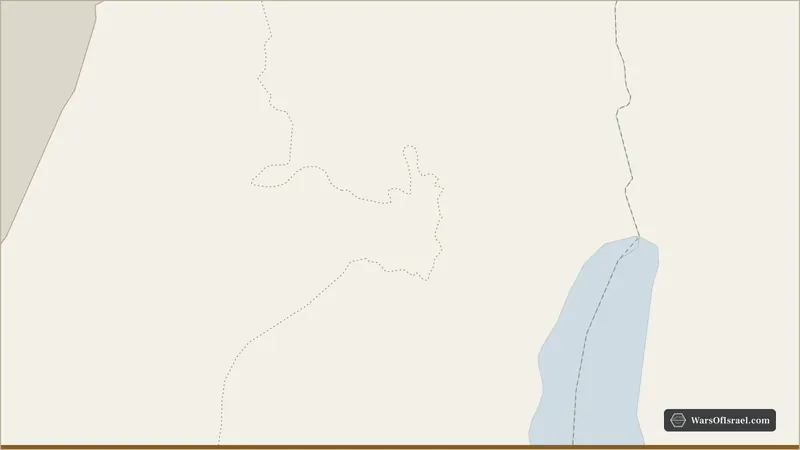
At Modiin, in the foothills northwest of Jerusalem, the royal officer called on the elderly priest Mattathias to sacrifice first as an example. According to 1 Maccabees he refused, killed a Jew who stepped forward to sacrifice and the king's officer, and fled to the hills with his five sons: John, Simon, Judah, Eleazar and Jonathan. Groups of pious Jews, the Hasidim, joined them. When a band of refugees was attacked on the Sabbath and allowed itself to be killed rather than fight, Mattathias and his followers decided to fight on the Sabbath when attacked, a decision with lasting consequences in Jewish law.
Judah Maccabee's battles
Mattathias died in 166 BCE, and command passed to Judah. The meaning of the name Maccabee is uncertain; the most common explanation links it to the Hebrew word for hammer. His war, as reconstructed by the historian Bezalel Bar-Kochva from the two Books of Maccabees, moved through several stages: - the defeat of Apollonius, the governor of Samaria, whose sword Judah took and used for the rest of his life; - an ambush on the ascent of Beth Horon, where Seron, a Seleucid commander, was routed in a narrow pass; - the campaign of Emmaus in 165 BCE, in which Judah slipped away from his camp at night as Gorgias tried to surprise it, attacked the main Seleucid camp at dawn, and then faced Gorgias's returning force, which retreated; - the battle of Beth Zur, south of Jerusalem, against the regent Lysias, after which the road to the Temple Mount lay open.
The figures in the sources are a problem in their own right. 1 Maccabees speaks of 40,000 foot soldiers and 7,000 horsemen at Emmaus, and of 3,000 men with Judah. Bar-Kochva argues that the Seleucid numbers are inflated and that by the later battles Judah could field forces comparable in size to the royal armies, so that the image of a tiny band beating huge hosts owes more to the pious historiography than to the battlefield.
The Temple, Hanukkah and the later campaigns
In December 164 BCE, on the 25th of Kislev, three years after the pagan altar was set up, according to 1 Maccabees, Judah's men purified the Temple, built a new altar and celebrated its dedication for eight days. Antiochus IV died on campaign in the east at about the same time. 2 Maccabees explains the eight days as a delayed celebration of the festival of Sukkot. The story of a single cruse of oil that burned for eight days appears for the first time in the Babylonian Talmud, centuries later; it is a tradition, not part of the earliest accounts.
The war did not end with the rededication. Judah campaigned to rescue Jewish communities in Gilead and the Galilee, while Simon fought in the Galilee. In 162 BCE, at Beth Zechariah, Lysias returned with a large army that included war elephants; Judah's brother Eleazar was killed when he stabbed an elephant from below and was crushed beneath it, and the Jews were defeated. Lysias besieged Jerusalem but withdrew because of a power struggle at home, and the Seleucid government revoked the decrees of persecution. From then on the fight was less about religious freedom and more about who would rule Judea.
The new king, Demetrius I, appointed Alcimus high priest and sent Nicanor to support him. On the 13th of Adar, at Adasa near Beth Horon, Judah defeated Nicanor, who was killed; the day was celebrated as Nicanor Day. Judah sent envoys to Rome and, according to 1 Maccabees, concluded a treaty of friendship. Within months Demetrius sent Bacchides with a stronger force. At Elasa in 160 BCE, with only part of his army remaining, Judah attacked the Seleucid right wing and was killed in battle. His brothers Jonathan and Simon took his body for burial in Modiin.
After Judah: from revolt to the Hasmonean state
Jonathan led the remaining fighters from the Judean desert and, exploiting the civil wars among Seleucid claimants, became high priest in 152 BCE. After he was captured and killed in 143 BCE, Simon succeeded him. In 142 BCE, according to 1 Maccabees, "the yoke of the gentiles was removed from Israel"; in 141 BCE Simon took the Akra; and an assembly in 140 BCE recognized him as high priest, commander and leader. The dynasty he founded, known as the Hasmoneans after an ancestor named in Josephus, ruled for about 80 years, expanded by conquest and was ended by internal strife and the arrival of Rome under Pompey in 63 BCE.
The road from Pompey to the revolts against Rome is told in the article on the Great Revolt and the siege of Masada, and the last great uprising in the article on the Bar Kokhba revolt. The earlier wars of the kingdoms of Israel and Judah are summarized in the overview of the wars of ancient Israel.
Memory and meaning
Rabbinic Judaism remembered the revolt cautiously. The Mishnah barely mentions it, and the festival of Hanukkah was framed in the Talmud around the miracle of the oil rather than military victory. The Books of Maccabees were preserved not by the Jews but by the Church, and they entered the Catholic and Orthodox Bibles; Christian tradition venerated the martyrs of 2 Maccabees, the old scribe Eleazar and the mother with her seven sons.
The Zionist movement turned the Maccabees into a symbol of Jewish self-defense. Sports clubs took the name Maccabi, schools staged the battles, and torch relays from Modiin became a Hanukkah ritual in the State of Israel. How modern Israel names its operations and remembers its wars, often reaching back to such ancient images, is the subject of the guides on how Israel's wars are named and on commemoration and memorial days. Historians, for their part, read the same events as a civil war among Jews as much as a war against an empire, and both readings are supported by the sources.