Wars and conflicts: background, events and consequences

Start with the wider conflict before following its individual battles.

A war brings together events that may unfold on several fronts, involve different forces and continue through distinct phases. This index gives that wider setting. It includes wars and prolonged conflicts as well as campaigns, uprisings and riots, with the type identified for each record. Those labels help organize the history; they do not imply that every event had the same scale, legal status or course.

Open a record to understand the background, the parties involved and the outcome. Links connect the broader account to individual battles and operations, which may have their own objectives and results. A military success in one encounter does not, by itself, explain the outcome of the entire conflict. Where the beginning, endpoint or interpretation is disputed, the account identifies the source and the limits of what can be established.

31 recordsExploreTimeline

Late Ottoman period1900 to 1917

  1. April 12, 1909 to 1920Hashomer and the defense of Jewish settlements (1909 to 1920)Conflict

British Mandate1917 to 1947

Riots and disturbancesApril 4, 1920 to April 7, 1920

The 1920 Jerusalem riots (Nebi Musa)

From April 4 to 7, 1920, during the Nebi Musa festival, Arab crowds attacked Jews in Jerusalem's Old City. Five Jews and four Arabs were killed and over two hundred people injured, and the riots led to the Haganah's founding.

Riots and disturbancesMay 1, 1921 to May 7, 1921

The 1921 Jaffa riots

Between May 1 and 7, 1921, violence that began in Jaffa during May Day marches spread to Petah Tikva, Hadera and other colonies. The Haycraft Commission counted 47 Jews and 48 Arabs killed, among them the writer Yosef Haim Brenner.

Riots and disturbancesAugust 23, 1929 to August 29, 1929

The 1929 riots: Jerusalem, Hebron and Safed

A week of Arab attacks on Jews in August 1929, sparked by the dispute over the Western Wall and culminating in the Hebron and Safed massacres. The Shaw Commission counted 133 Jews and 116 Arabs killed.

UprisingApril 19, 1936 to 1939

The 1936 to 1939 Arab revolt in Mandatory Palestine

An Arab uprising against British rule and Jewish immigration that began with a general strike in April 1936, became an armed rebellion and peaked in 1938. Britain crushed it in 1939, but it led to the Peel Commission and the 1939 White Paper.

ConflictFebruary 1, 1944 to November 29, 1947

The Jewish armed struggle against British rule (1944 to 1947)

The armed campaign of the Irgun, Lehi and for a time the Haganah against the British Mandate, from the revolt declaration of February 1944 to the partition vote of November 1947, combining sabotage, attacks and illegal immigration.

  1. 1930 to November 20, 1935Izz ad-Din al-Qassam's armed group (1930 to 1935)Conflict
  2. June 1938 to 1939The Special Night Squads (1938)Campaign
  3. September 20, 1944 to 1946The Jewish Brigade in the Second World War (1944 to 1945)Campaign

War of Independence1947 to 1949

WarNovember 30, 1947 to July 20, 1949

The 1947 to 1949 war: Israel's War of Independence

The war that began the day after the UN partition vote, became a war against Arab state armies when Israel was declared, and ended with the 1949 armistice agreements. It fixed Israel's lines and created the Palestinian refugee problem.

Early statehood1949 to 1967

WarOctober 29, 1956 to November 5, 1956

The 1956 Suez crisis and the Sinai campaign (Operation Kadesh)

In October and November 1956 Israel captured Sinai and the Gaza Strip in secret coordination with Britain and France. American and Soviet pressure forced a withdrawal, but the Straits of Tiran opened and the Gaza border went quiet.

  1. November 1964 to April 7, 1967The war over water (1964 to 1967)Conflict

Six-Day War to Yom Kippur1967 to 1973

WarJune 5, 1967 to June 10, 1967

The Six-Day War (1967)

A six-day war in June 1967 between Israel and Egypt, Jordan and Syria that left Israel holding Sinai, the Gaza Strip, the West Bank, East Jerusalem and the Golan Heights, redrawing the map of the Middle East.

WarJuly 1, 1967 to August 7, 1970

The War of Attrition (1967 to 1970)

A grinding war of artillery duels, commando raids and air battles, mainly against Egypt along the Suez Canal, in which Soviet pilots and missile crews took part in its final stage. It ended in a ceasefire on August 7, 1970, with the lines unchanged.

WarOctober 6, 1973 to October 25, 1973

The Yom Kippur War (1973)

On Yom Kippur, October 6, 1973, Egypt and Syria launched a surprise attack on Israel in Sinai and the Golan Heights. Israel halted both offensives, crossed the Suez Canal and advanced into Syria, but the war's cost and the intelligence failure changed the country.

Lebanon and the first intifada1974 to 1999

WarJune 6, 1982 to June 1985

The 1982 Lebanon War (Operation Peace for Galilee)

On June 6, 1982, Israel invaded Lebanon to push the PLO away from the Galilee, fought the Syrian army and besieged Beirut. The PLO was expelled, but the war led to Sabra and Shatila, the Kahan Commission and a long stay in southern Lebanon.

ConflictJune 1985 to May 24, 2000

The South Lebanon security zone conflict (1985 to 2000)

For fifteen years the IDF and the South Lebanon Army held a strip of southern Lebanon along the border against a sustained Hezbollah guerrilla campaign, until Israel's unilateral withdrawal on May 24, 2000.

UprisingDecember 9, 1987 to September 13, 1993

The first intifada (1987 to 1993)

A mass Palestinian uprising in the West Bank and Gaza Strip that broke out in December 1987, lasted about six years and reshaped the conflict on the road to the Oslo Accords.

Second intifada to the Gaza operations2000 to 2023

UprisingSeptember 29, 2000 to 2005

The second intifada (2000 to 2005)

An armed Palestinian uprising that began in September 2000 after the Camp David summit failed, marked by suicide bombings in Israeli cities and Israeli operations in the West Bank and Gaza. It buried the Oslo process and faded in 2005.

WarJuly 12, 2006 to August 14, 2006

The Second Lebanon War (2006)

Thirty-four days of fighting between Israel and Hezbollah, triggered by a cross-border raid on July 12, 2006 and ended by UN Security Council Resolution 1701. Close to 4,000 rockets struck northern Israel.

  1. January 30, 2013 to December 8, 2024The campaign between the wars: Israeli strikes in Syria (2013 to 2024)Conflict
  2. March 31, 2022 to 2025Israeli counter-terrorism operations in the West Bank (2022 to 2025)Conflict

Since October 7, 20232023 to the present

WarOctober 7, 2023 to ongoing

The Israel and Hamas war (from October 7, 2023)

The war that began with the Hamas attack on southern Israel on October 7, 2023 and was fought mainly in the Gaza Strip. A ceasefire took effect on October 10, 2025 and all living hostages were freed, but the war has not formally ended.

WarOctober 8, 2023 to November 27, 2024

The Israel and Hezbollah war (2023 to 2024)

A 14-month war on Israel's northern border that Hezbollah opened on October 8, 2023, which became an Israeli offensive in September 2024, killed Hassan Nasrallah and ended with a ceasefire on November 27, 2024.

WarFebruary 28, 2026 to ongoing

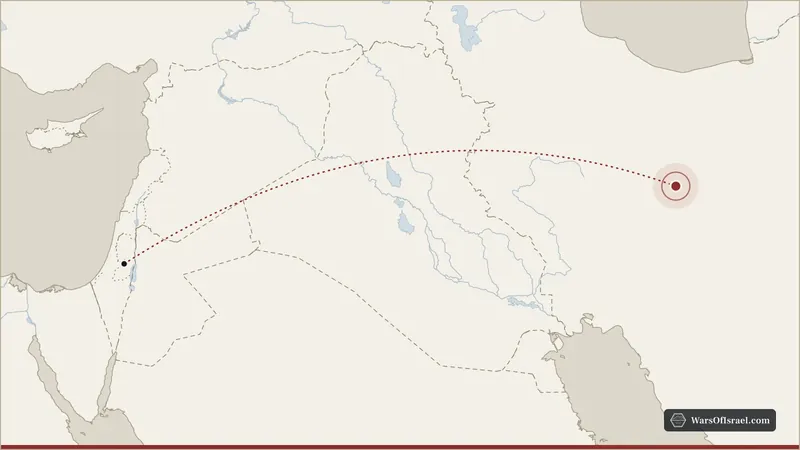
The Israel and Iran war of 2026 (Operation Roaring Lion)

The war Israel and the United States opened against Iran on February 28, 2026, which killed Ali Khamenei and brought about 650 ballistic missiles on Israel; the April 8 ceasefire collapsed between Washington and Tehran in July.

  1. October 19, 2023 to ongoingIsrael and the Houthis in Yemen (from 2023)Conflict
  2. March 2, 2026 to ongoingThe 2026 war with Hezbollah in LebanonWar