News
IDF selects head of planned space division as Katz sets military goals
A senior command appointment gives the IDF's space plans a concrete next step. Official accounts connect the initiative to capabilities already supporting operations against Iran.

On October 20, 2026, Defense Minister Israel Katz backed the establishment of an IDF space division and outlined a goal of expanding Israel's military capabilities in space, following the military's selection of a commander on October 19. The IDF named Brig. Gen. Sh. to lead the planned formation, while explicitly stating that the appointments announced that day required the defense minister's approval.
The development gives the space initiative a designated senior commander and a public policy objective. It does not establish that a new weapons system has entered service. Katz's ambitions extend to offensive capabilities, but the published announcement contains no operational specifications or timetable for deploying them.
A command appointment with a formal condition
The [IDF's October 19 appointment announcement](https://www.idf.il/353558) records decisions taken at a personnel discussion chaired by Chief of Staff Lt. Gen. Eyal Zamir. Its opening condition applies to the entire list: the appointments depend on approval by Katz. The selection of the space division's head therefore represents a documented personnel decision, with the formal approval requirement retained in the military's own account. Space was part of a broader set of appointments involving emerging military capabilities. The same official list selected Brig. Gen. Y. to head a robotics division in the Depth Command and Col. A. to lead the Ground Forces' multidimensional attack division, with promotion to brigadier general. It also selected Col. Sh. to head the space constellations department in the Defense Ministry's Directorate of Defense Research and Development, known as MAFAT. These are separate posts. Their appearance together establishes that the appointment round covered several fields of force development; it does not place the robotics or multidimensional attack formations under the space division.
The connection to the Iran campaign
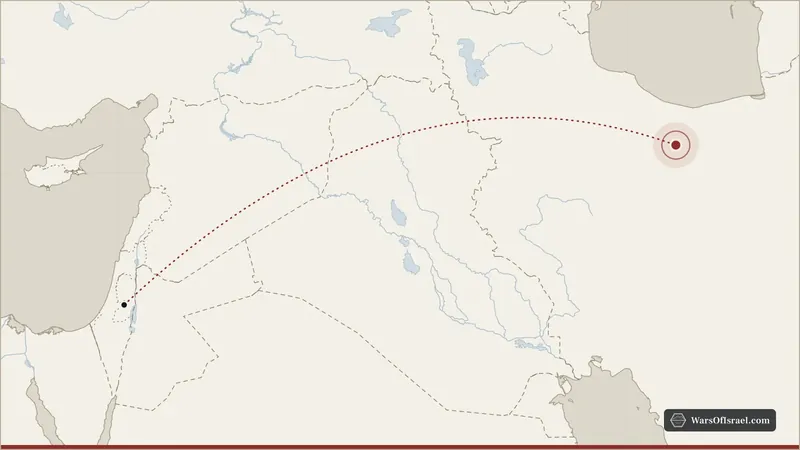
An earlier Defense Ministry account shows why space capabilities already have practical military value. On March 5, 2026, the ministry said Director General Maj. Gen. (res.) Amir Baram had visited Israel Aerospace Industries' space facilities and an operational ground station serving part of the defense establishment's satellite network. The ministry said Baram reviewed operational satellite images arriving from the fighting in Iran and discussed the contribution of space developments to IDF strikes. Baram described their uses as intelligence support for combat and operations, target generation and the connection between intelligence and action. Those descriptions are the ministry's assessment of its own capabilities. Baram also identified the organizations involved: engineers from Israel Aerospace Industries and MAFAT, alongside personnel from Unit 9900, the C4I Directorate and the air force. The March account documents cooperation among existing bodies. It provides background to the October initiative without attributing those earlier operations to a division whose command appointment had not yet been announced.
Building a dedicated military profession
In its October 20 report, TPS carried an IDF description of the planned division as a body intended to develop forces and operations, organize professional knowledge and training, and establish space as a dedicated military field. TPS reported that it would sit within the Planning Directorate. These are the military's stated organizational objectives, rather than a published inventory of new equipment. Taken together, the described tasks point to a need to connect technological development, personnel training and military requirements. That is the organizational significance of the published remit: a satellite project, the people trained to use its products and the commanders setting operational needs must fit into a common planning process. The precise allocation of authority between the new division and existing organizations remains unspecified. Katz supplied the wider policy ambition. In his statement reproduced by JNS, he said Israel should become one of the leading countries in military space capabilities and be able to "monitor, defend and strike from space." TPS also carried his stated goal of strengthening deterrence against nearby and distant enemies. Those statements describe the defense minister's intended direction.
What the announcements establish
The distinction between organization and capability is central to reading the announcement. Selecting a commander establishes who has been chosen for a post. Defining a mission explains what the formation is intended to pursue. Neither step, by itself, identifies a weapon, proves that it has been tested or confirms that it is available for use. The published accounts do not provide a budget, a staffing figure, an activation date or a detailed division of responsibilities. They also do not disclose the technical means behind Katz's offensive ambitions. Assigning a particular weapon or operational method to the new division would therefore go beyond what has been announced.