BattleSix-Day War to Yom Kippur
The battle of Ammunition Hill (1967)
Why a fortified hill in north Jerusalem cost 107 lives in four hours on June 6, 1967, and how it became Israel's memorial to the battle for the city.
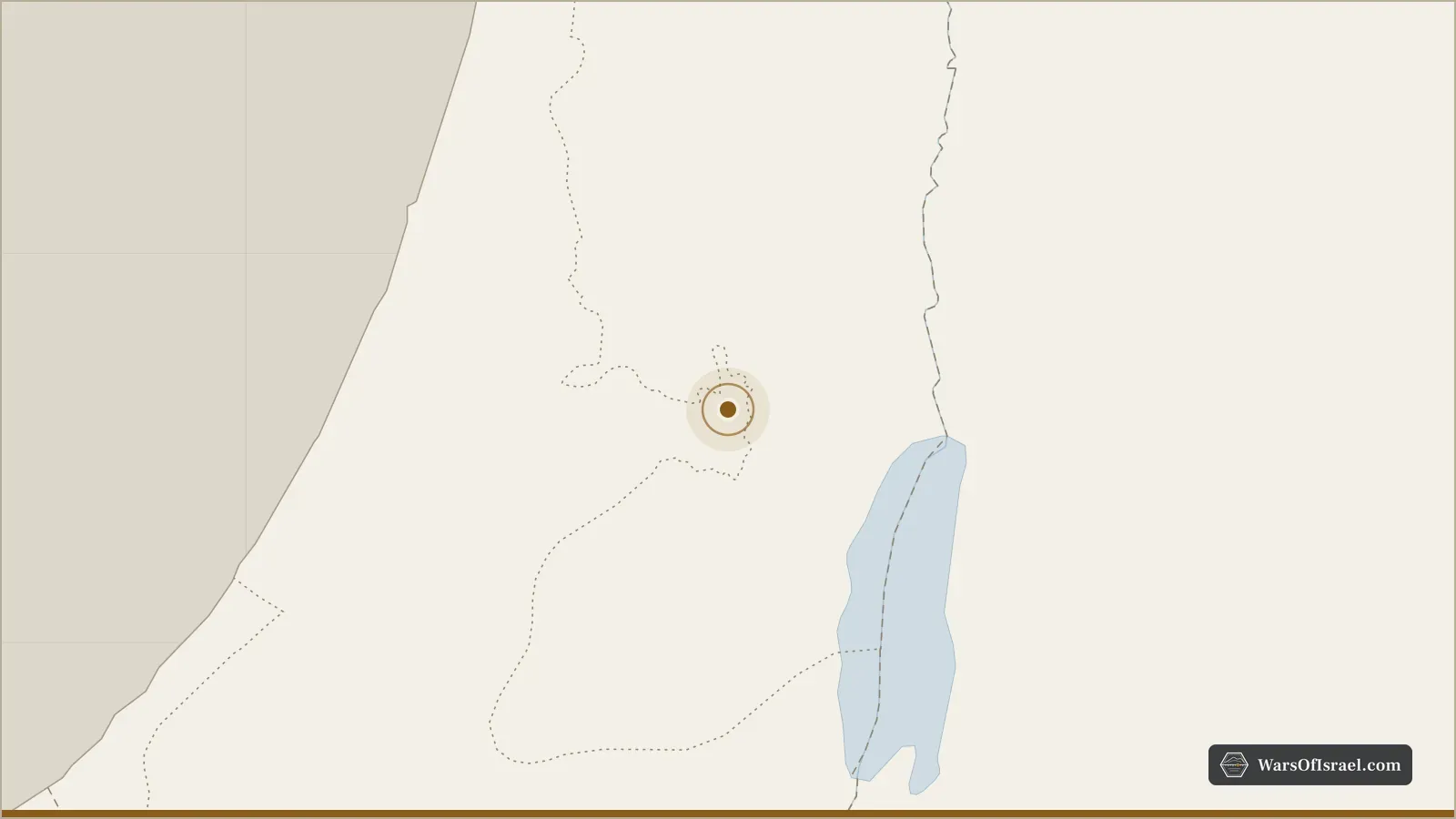
The battle of Ammunition Hill was fought in the dark early hours of June 6, 1967, on a fortified Jordanian position in the north of Jerusalem. Over about four hours, from roughly 2:30 to 6:30 a.m., paratroopers of the 66th Battalion fought trench by trench against a Jordanian force of about the same size. Thirty-six Israeli soldiers and 71 Jordanian soldiers were killed. The battle opened the road to Mount Scopus and became the defining memory of the battle for Jerusalem in the Six-Day War.
A position built for a siege
Ammunition Hill (Givat HaTahmoshet) stands on the western slope of Mount Scopus, between the neighborhoods of Sheikh Jarrah and what is today Ramat Eshkol. Its name goes back to the British Mandate. In the 1930s the British built a police training school on the slope, and the hill above it was used to store the school's ammunition.
In the fighting of 1948 the Jordanian Arab Legion took the hill and the Police School. The position cut the road between Israeli West Jerusalem and the Israeli enclave on Mount Scopus, where the Hebrew University and Hadassah Hospital had stood before the war (see the battle for Jerusalem in 1948). For nineteen years the Jordanian army fortified it. By 1967 it was a network of bunkers along three main trench lines, each covered by fortified firing positions, with a large underground bunker where the garrison lived. A connecting trench linked the hill to the Police School below.
The plan and the intelligence
When Jordan entered the war on June 5, Israel's Central Command, under Maj. Gen. Uzi Narkiss, decided to encircle the Jordanian part of Jerusalem from the north and to reconnect Mount Scopus. The task in the city fell to the 55th Paratroopers Brigade under Col. Mordechai Gur, a reserve brigade that had been preparing to drop into Sinai and was moved to Jerusalem that day. Its battalions had only hours to study the ground, much of it seen for the first time from rooftops in the Israeli neighborhoods along the armistice line.
The 66th Battalion, commanded by Lt. Col. Yossi Yaffe, was given the Police School and Ammunition Hill. The planners decided not to use air strikes, because the position was close to civilian neighborhoods on both sides of the line. Instead, artillery would shell the Police School, and an enlarged paratroop company would then take the hill.
The intelligence was wrong in one important respect. The planners believed the hill was held by about a platoon. In fact a reinforced company of about 150 soldiers of the Jordanian army's 2nd El Hussein Battalion held the position. When the Israeli bombardment began, the soldiers in the Police School withdrew through the connecting trench into the bunkers on the hill, so that the attackers found the school almost empty and the hill defended by a force roughly equal to their own, about three times what they had expected.
The battle in the trenches
Crossing the line
The paratroopers crossed the armistice line in the early hours of June 6 under fire, breaching fences and minefields, and took the Police School with relatively little fighting. The 3rd Company of the 66th Battalion then turned toward Ammunition Hill, and part of the 2nd Company was sent in during the battle to reinforce it.
Trench by trench
What followed was close combat in narrow trenches, often at a distance of a few meters, in darkness broken by flares and explosions. The paratroopers split into small groups, each moving along a different trench line, clearing bunkers one by one with grenades and small-arms fire. The Jordanian soldiers fought from positions they knew well, and many held their ground until they were killed. Several Israeli officers and soldiers were killed leading their squads forward, and the attacking groups grew smaller as the night went on.
The fighting continued until about 6:30 a.m. Even after the main position fell, the paratroopers stayed down in the trenches because of sniper fire from Givat HaMivtar, a Jordanian position to the north, which the Harel Brigade overran later that day.
The cost
Thirty-six Israeli soldiers and 71 Jordanian soldiers were killed on Ammunition Hill, the figures generally given in Israeli and international accounts of the battle. Dozens more were wounded. For the 66th Battalion it was the costliest night of the war. Ten of the soldiers who fought on the hill later received the IDF chief of staff's citation for their conduct in the battle.
The attackers' own accounts describe a Jordanian garrison that fought hard from its bunkers and did not abandon the position, which helps explain why the toll was so high on both sides.
What the battle achieved
By the morning of June 6 the northern defenses of Jordanian Jerusalem had been broken. The paratroopers' other battalions reached the Rockefeller Museum outside the walls of the Old City, and the road to Mount Scopus was opened for the first time since 1948. Together with the Harel Brigade's advance through the hills to the north, the battle completed the encirclement of the Jordanian part of the city. A day later, on June 7, Gur's paratroopers entered the Old City through the Lions' Gate.
For the small Israeli garrison on Mount Scopus, the result ended nineteen years of isolation. Under the armistice arrangements of 1949, the enclave had been held by a few dozen Israeli policemen, relieved every two weeks by a convoy that crossed Jordanian territory under UN escort, carrying supplies that were inspected on the way. The buildings of the Hebrew University and Hadassah Hospital on the mountain had stood empty since 1948. Within days of the battle, Israelis could drive up to Mount Scopus on an open road, and in the years that followed both institutions returned to their original campus, which stands a short walk from the hill where the road was opened.
Military historians have debated whether the frontal assault on Ammunition Hill was necessary, or whether the position could have been isolated and left to fall once the city was surrounded. The planners in 1967 saw it as a threat to the advance and to the route to Mount Scopus, and they worked from intelligence that badly underestimated its garrison. The debriefings that Yaffe held with his officers after the battle are among the documents preserved by the IDF and Defense Establishment Archives in its exhibition on the Six-Day War (opens in a new tab).
Memory: the hill as a memorial
Ammunition Hill quickly became a symbol. In October 1967 the IDF weekly Bamahane published interviews with veterans of the battle, and the songwriter Yoram Taharlev turned their words into the song "Givat HaTahmoshet," performed by the Central Command Band. It became one of the best-known Israeli songs about war, and one of the most somber.
In 1975 a memorial site and museum opened on the hill. Part of the Jordanian position, with its trenches and bunkers, was preserved; the museum is housed in the bunker. On the hill, 182 olive trees commemorate the 182 Israeli soldiers who fell in the fighting for Jerusalem in 1967. The site was declared a national memorial in 1987. The state ceremony of Jerusalem Day is held there, and it serves as a place where paratroopers are sworn in.
Today the hill stands among residential neighborhoods and beside a light rail line, a quiet garden around the old trenches. The contrast between the setting and the history is part of what visitors remember.
Timeline
- 1930s: The British build a police training school on the slope; the hill above stores its ammunition.
- 1948: The Jordanian Arab Legion takes the Police School and Ammunition Hill, cutting off Mount Scopus.
- June 5, 1967: Jordan enters the war; the 55th Paratroopers Brigade is moved to Jerusalem.
- June 6, 1967 (about 2:30 a.m.): The 66th Battalion crosses the armistice line and takes the Police School.
- June 6, 1967 (about 6:30 a.m.): The last Jordanian positions on Ammunition Hill fall; the road to Mount Scopus is open.
- June 7, 1967: The paratroopers enter the Old City.
- October 1967: Bamahane publishes veterans' accounts; Yoram Taharlev writes the song "Givat HaTahmoshet."
- 1975: The memorial site and museum open on the hill.
- 1987: Ammunition Hill is declared a national memorial site.