The Six-Day War (1967)
How a three-week crisis became a six-day war that tripled the territory under Israeli control and set the terms of every conflict and negotiation since.
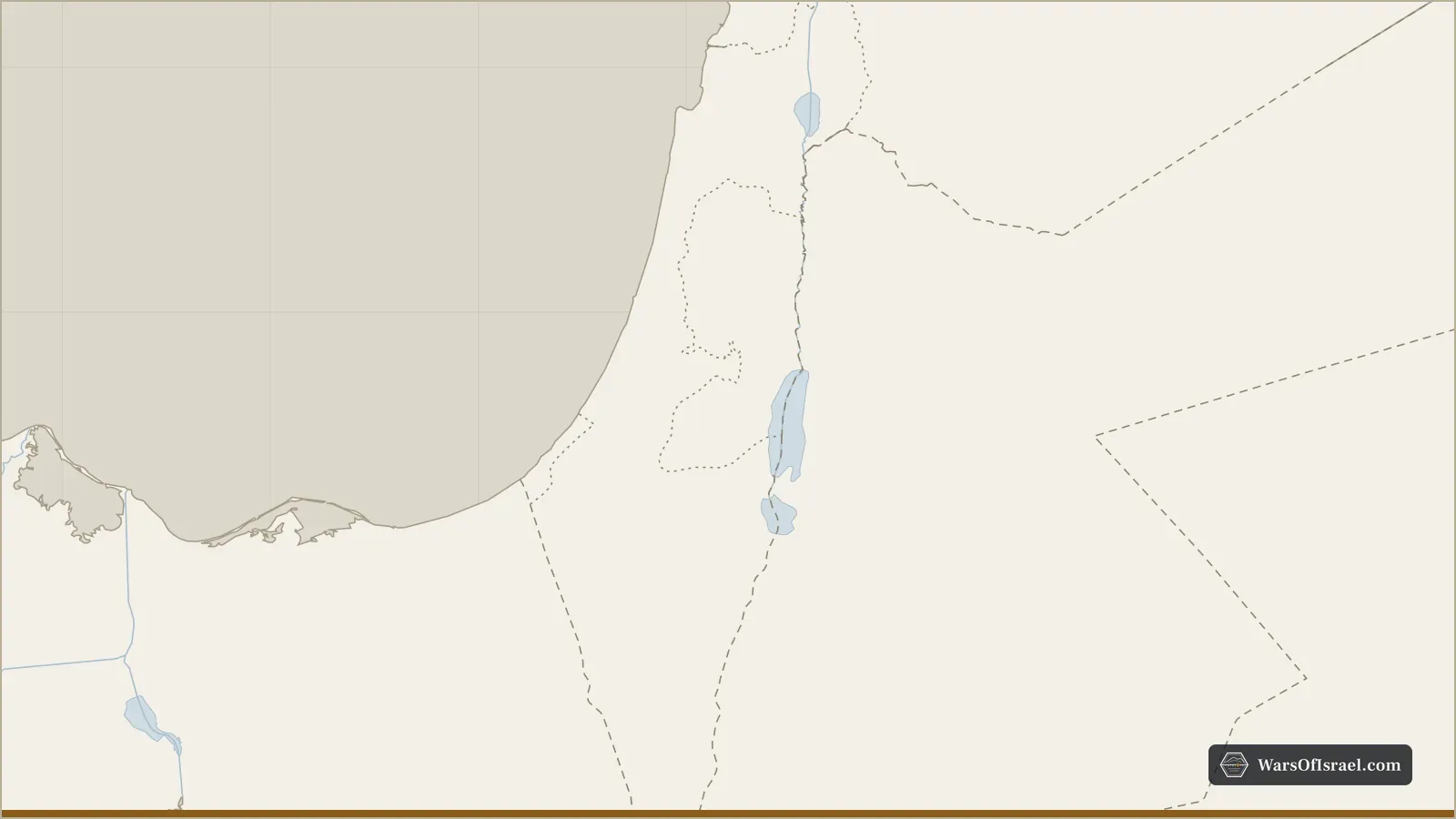
Between the morning of June 5 and the evening of June 10, 1967, Israel fought Egypt, Jordan and Syria and ended the war holding territory more than three times its own pre-war size: the Sinai Peninsula and the Gaza Strip, the West Bank including East Jerusalem, and the Golan Heights. The decisive blow came in the first three hours, when the Israeli Air Force destroyed most of Egypt's air force on the ground. The war lasted six days; the questions it raised about borders, refugees, Jerusalem and peace have shaped the region ever since.
Background: from the Sinai campaign to the crisis of May 1967
The roots of the crisis lay in the settlement that followed the Sinai campaign of 1956. Israel withdrew from Sinai in 1957 in exchange for the deployment of a United Nations Emergency Force (UNEF) along the border and at Sharm el-Sheikh, which commands the Straits of Tiran and the sea route to Eilat. Israel declared at the time that closing the straits to its shipping would be treated as an act of war.
The decade that followed was quiet on the Egyptian border and tense everywhere else. Syria and Israel clashed repeatedly over the demilitarized zones and over Arab plans to divert the headwaters of the Jordan River, the struggle known in Israel as the war over water. Palestinian Fatah cells, many supported by Syria, began cross-border attacks in 1965. In November 1966 an Israeli reprisal against the West Bank village of Samu, then under Jordanian rule, turned into a battle with the Jordanian army and shook King Hussein's government. On April 7, 1967, an air battle over the Golan ended with six Syrian MiG fighters shot down, some of them within sight of Damascus.
In mid-May the Soviet Union passed Egypt a report, which proved false, that Israel was massing troops on the Syrian border. Egyptian President Gamal Abdel Nasser sent large forces into Sinai, demanded the withdrawal of UNEF, and on May 22 announced that the Straits of Tiran were closed to Israeli shipping. Within ten days a regional crisis had become a countdown.
The waiting period and the decision to strike
The three weeks before the war entered Israeli memory as the "waiting period" (Tkufat HaHamtana). Israel mobilized its reserves, which brought much of the economy to a halt, while Foreign Minister Abba Eban sought diplomatic support in Paris, London and Washington. France, until then Israel's main arms supplier, warned it not to fire first. The United States explored the idea of an international flotilla to reopen the straits, but it never materialized.
Public anxiety grew. A halting radio address by Prime Minister Levi Eshkol on May 28 deepened the sense that the leadership was unsure of itself, and rabbis consecrated parks as possible emergency cemeteries. On May 30 King Hussein flew to Cairo and signed a defense pact with Egypt, placing Jordanian forces under the command of the Egyptian general Abdul Munim Riad; Iraqi forces began moving toward Jordan. Israel now faced the prospect of a war on three fronts.
On June 1 Eshkol broadened his government into a national unity cabinet. Moshe Dayan, the chief of staff of the 1956 campaign, became defense minister, and Menachem Begin of the opposition Gahal party joined as a minister without portfolio. On June 4 the cabinet approved military action. The chief of staff, Lt. Gen. Yitzhak Rabin, had a plan ready that rested on one condition: the air force had to win the first morning.
The forces on the eve of war
Israel fielded about 264,000 soldiers once its reserves were mobilized, with roughly 800 tanks and a few hundred combat aircraft. Its army was built for a short war, because a country that sends most of its working men to the front cannot keep them there for long.
Egypt had concentrated an army that most historians estimate at about 100,000 men in Sinai, with several hundred tanks and an air force of more than 400 modern combat aircraft supplied by the Soviet Union. A significant part of its army was still tied down in the civil war in Yemen. Jordan's army, the former Arab Legion, held the West Bank and East Jerusalem with professional but outnumbered brigades. Syria's army of about 75,000 sat in fortified positions on the Golan Heights, looking down on the Hula and Jordan valleys and on the kibbutzim below.
Israel's advantage lay less in numbers than in preparation, training and the plan for the opening strike. The Arab coalition's weakness lay in coordination: three armies with separate commands, poor communications and leaders who did not fully trust one another.
The course of the war
June 5: the air strike and the opening of three fronts
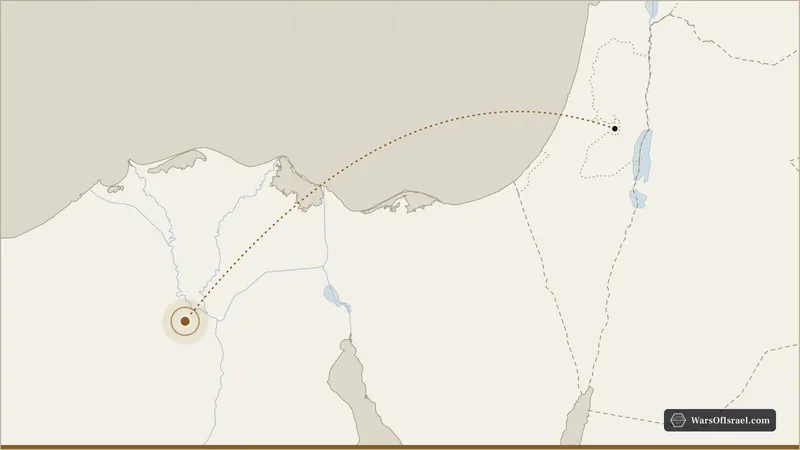
At about 7:45 a.m. Israel time, the first wave of Israeli aircraft struck Egyptian airfields after flying low over the Mediterranean to evade radar. The operation, code-named Moked, is described in detail in the article on Operation Focus. According to historian Michael Oren, Egypt had lost 286 combat aircraft by the end of the morning. Later that day Israel struck the air forces of Jordan and Syria and an Iraqi base. Air Force commander Mordechai Hod told a later inquiry that only a small fraction of the Egyptian air force had survived.
On the ground, three divisions crossed into Sinai and the Gaza Strip. At about 10:00 a.m. Jordan opened fire along the armistice line, including a heavy bombardment of Israeli Jerusalem, and Jordanian troops seized Government House, the UN headquarters south of the city. Syrian artillery shelled the Israeli communities of the Hula Valley and the Sea of Galilee.
Sinai and Gaza
In the north of Sinai, Maj. Gen. Israel Tal's division broke through the defenses at Rafah and Khan Yunis and pushed along the coast toward El Arish. In the center, Maj. Gen. Ariel Sharon's division stormed the fortified complex at Umm Katef and Abu Ageila in a night battle that military historians still study (see the battle of Abu Ageila). Between them, Maj. Gen. Avraham Yoffe's division crossed the dunes to block Egyptian reinforcements. The Gaza Strip was taken by June 6.
That day Egyptian Field Marshal Abdel Hakim Amer ordered a general withdrawal from Sinai. The retreat turned into a rout. Israeli forces raced to the Mitla and Gidi passes to cut off the fleeing columns, took Sharm el-Sheikh on June 7, and by June 9, according to the IDF Archives, held all of Sinai up to the Suez Canal and the Gulf of Suez.
Jerusalem and the West Bank
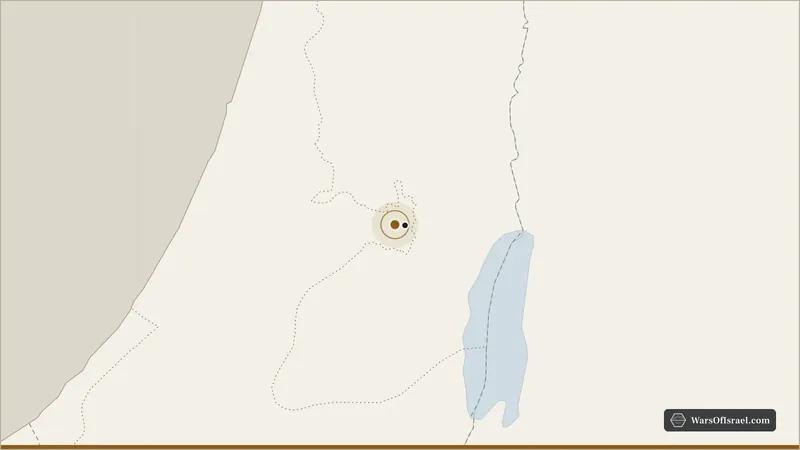
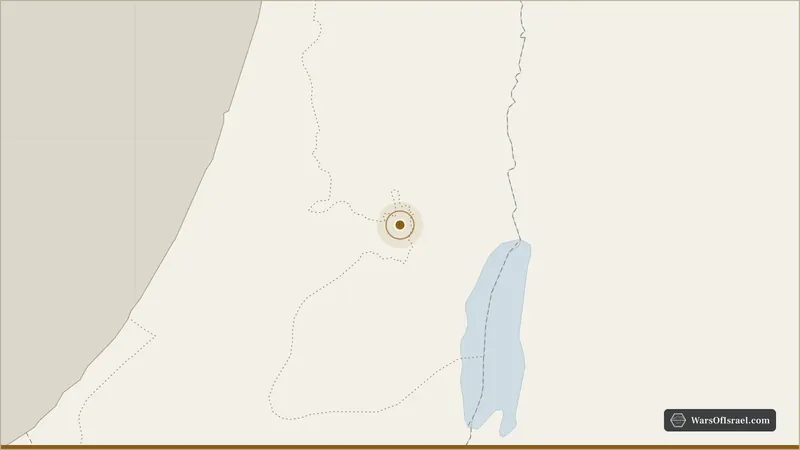
Israel had hoped Jordan would stay out of the war, and messages passed through the UN urged King Hussein to hold his fire. Hussein, misled by Egyptian reports of success, chose to fight. Israeli forces under Central Command chief Maj. Gen. Uzi Narkiss first retook Government House, then encircled the Jordanian-held part of Jerusalem from the north. On the night of June 5 to 6 the 55th Paratroopers Brigade broke through the city's northern defenses in the costly battle of Ammunition Hill, restoring the link with the Israeli enclave on Mount Scopus.
On the morning of June 7 the paratroopers entered the Old City through the Lions' Gate and reached the Temple Mount and the Western Wall, closed to Jews since 1948. The full story is told in the battle for Jerusalem. In the north of the West Bank, an armored division took Jenin and Nablus after fighting in the Dothan Valley; in the south, Bethlehem and Hebron fell with little resistance. Jordan withdrew its army across the Jordan River.
On June 8, off the Sinai coast, Israeli aircraft and torpedo boats attacked the American intelligence ship USS Liberty, killing 34 crew members. Israel said it had mistaken the vessel for an Egyptian ship; the USS Liberty incident remains disputed. Egypt accepted a UN ceasefire that evening.
The Golan Heights
For four days Dayan refused to open a full offensive in the north, fearing Soviet intervention. Delegations from the shelled northern communities pressed the government, and on the morning of June 9, after Egypt's acceptance of the ceasefire, Dayan ordered Northern Command chief Maj. Gen. David Elazar to attack. In two days of fighting up steep slopes against fortified lines, Israeli armor and infantry broke through at Tel Faher, Qala and Za'ura (see the battles for the Golan Heights) and reached Quneitra on June 10. The ceasefire took effect that evening.
Casualties and the human cost
According to the IDF and Defense Establishment Archives, 776 Israeli soldiers were killed and 2,593 wounded between June 5 and June 14, 1967; other Israeli tallies that include later deaths from wounds reach 983. About 20 Israeli civilians were killed in the Jordanian shelling of Jerusalem, according to Michael Oren.
Arab losses are less precisely documented. Estimates cited by historians put Egyptian dead and missing at about 9,800 to 15,000, Jordanian dead at about 700 and Syrian dead at 1,000 to 2,500. Thousands of soldiers, most of them Egyptian, were taken prisoner.
The war also displaced civilians on a large scale. Estimates of the number of Palestinians who fled or were driven from the West Bank to Jordan range from about 280,000 to 325,000, many of them refugees for the second time since 1948. About 100,000 Syrians left or were expelled from the Golan Heights.
Outcome and consequences
The military result was unambiguous. In his report to the government on June 11, Rabin said the major part of the Egyptian army, a considerable part of the Jordanian army and at least half of the Syrian army had been defeated. Israel now controlled about 70,000 square kilometers of new territory and a Palestinian population of about a million people.
At the end of June 1967 Israel extended its law and administration to East Jerusalem and an enlarged municipal area. The other territories were placed under military government. In the Old City, Dayan ordered the Israeli flag removed from the Dome of the Rock and left the administration of the Temple Mount to the Muslim religious trust, the Waqf, an arrangement that still underlies the status quo there.
Diplomatically, the war produced two documents that framed the decades to come. At the Arab summit in Khartoum, which ended on September 1, 1967, Arab leaders adopted the "three noes": no peace with Israel, no recognition and no negotiations. On November 22, 1967, the UN Security Council adopted Resolution 242, which called for the withdrawal of Israeli forces "from territories occupied in the recent conflict" and for the right of every state in the area to live in peace within secure and recognized boundaries. The absence of the word "the" before "territories" became a lasting subject of debate.
The Soviet Union broke off relations with Israel on June 10. Egypt closed the Suez Canal, which stayed shut until 1975. Within weeks, artillery duels along the canal signaled that the fighting was not over; they grew into the War of Attrition. Six years later, Egypt and Syria would attack Israel on the lines of 1967.
Legacy and memory
In Israel the war produced a rare mixture of relief and euphoria. Weeks of fear that the state might not survive ended in a victory that seemed to many to be almost miraculous, and the return to the Western Wall and the Old City gave it religious and national meaning far beyond its military result. Jerusalem Day, marking the reunification of the city under Israeli rule, became a national holiday. The image of three paratroopers at the Wall became one of the best-known photographs in Israeli history.
The war also opened arguments that remain unresolved. The settlement movement that began in the West Bank, Gaza, Sinai and the Golan after 1967, the question of land for peace, and the fate of the Palestinian population under Israeli rule all flow from those six days. In the Arab world the war is remembered as al-Naksa, the setback, a defeat that discredited Nasser's pan-Arabism and strengthened independent Palestinian organizations.
Historians continue to debate whether the war could have been avoided, how far Nasser intended to fight, and what Israel's leaders wanted beyond removing the immediate threat. On one point there is broad agreement: the Middle East of today, with its borders, its disputes and its peace treaties, was shaped by the outcome of the first week of June 1967.
Timeline
- May 22, 1967: Nasser announces the closure of the Straits of Tiran to Israeli shipping.
- May 30, 1967: King Hussein signs a defense pact with Egypt in Cairo.
- June 1, 1967: A national unity government is formed; Moshe Dayan becomes defense minister.
- June 4, 1967: The Israeli cabinet approves military action.
- June 5, 1967: Operation Focus destroys most of Egypt's air force; ground fighting begins in Sinai, Gaza and Jerusalem.
- June 6, 1967: Israeli paratroopers take Ammunition Hill; Abu Ageila and the Gaza Strip fall; Egypt orders a withdrawal from Sinai.
- June 7, 1967: Paratroopers enter the Old City of Jerusalem; Israeli forces take Sharm el-Sheikh.
- June 8, 1967: The USS Liberty is attacked off Sinai; Egypt accepts a ceasefire.
- June 9, 1967: Israel attacks the Golan Heights; Golani soldiers take Tel Faher.
- June 10, 1967: Israeli forces enter Quneitra; the ceasefire with Syria takes effect in the evening.
- November 22, 1967: The UN Security Council adopts Resolution 242.
Battles and operations in this war
- June 5, 1967Operation Focus: the opening air strike of the Six-Day War (1967)Military operation
- June 5, 1967 to June 7, 1967The battle for Jerusalem in the Six-Day War (1967)Battle
- June 5, 1967 to June 6, 1967The battle of Abu Ageila (1967)Battle
- June 6, 1967The battle of Ammunition Hill (1967)Battle
- June 8, 1967The USS Liberty incident (1967)Incident
- June 9, 1967 to June 10, 1967The battles for the Golan Heights and Tel Faher (1967)Battle