BattleSecond intifada to the Gaza operationsReference entry
The battle of Bint Jbeil (2006)
How a town chosen partly for its symbolism became one of the hardest and most debated battles of the Second Lebanon War.
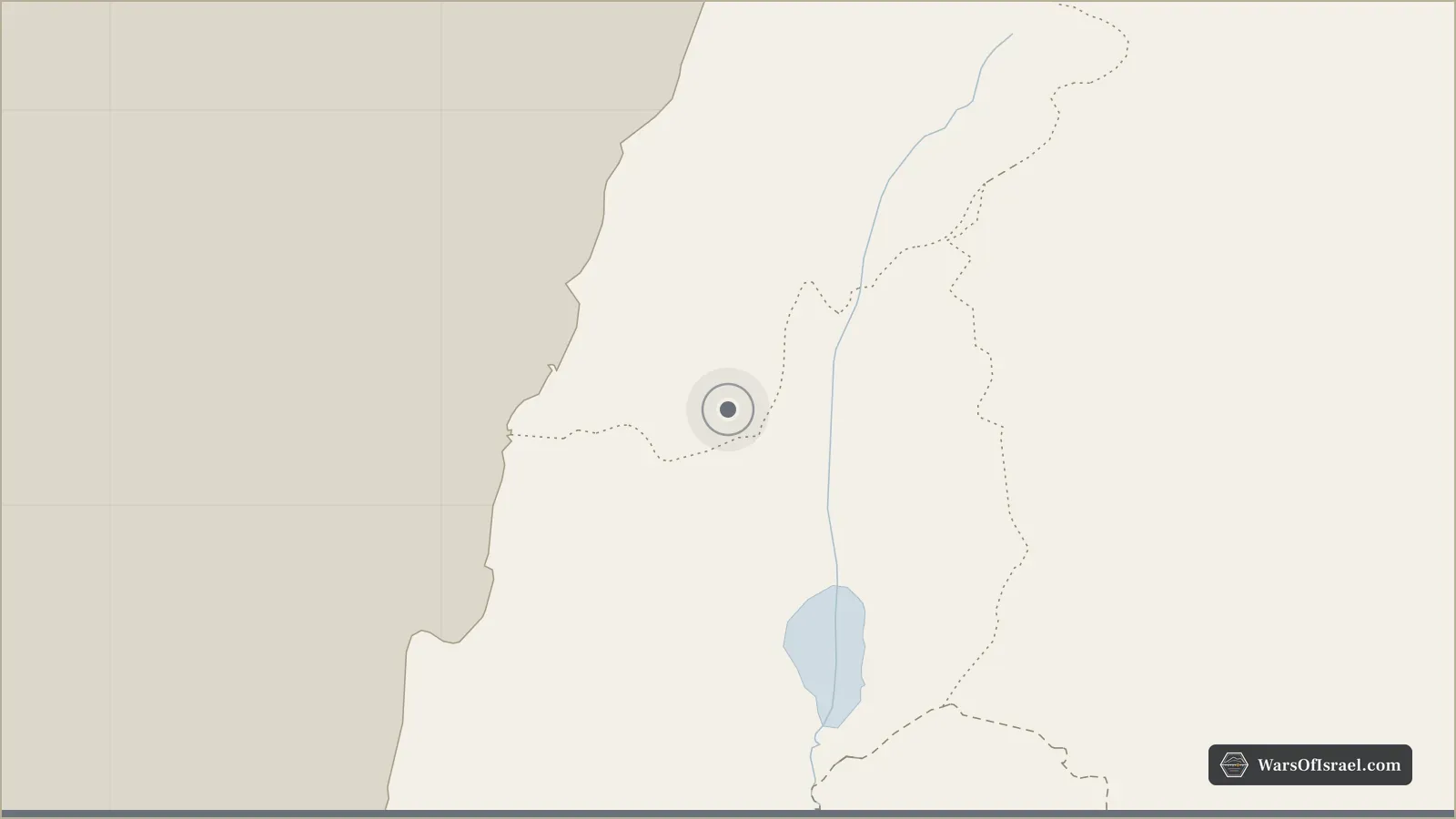
The battle of Bint Jbeil was a series of engagements fought by Israeli ground forces in and around the southern Lebanese town of Bint Jbeil between July 23 and August 11, 2006, during the Second Lebanon War. Its worst day came on July 26, when eight soldiers of the Golani Brigade's 51st Battalion were killed in close-range fighting on the edge of the town. Israeli forces entered and left the area several times, but never took and held the town, and Hezbollah fighters were still there when the ceasefire took effect on August 14. The battle became one of the defining images of a war that Israel's own commission of inquiry later called a missed opportunity.
Why Bint Jbeil
Bint Jbeil is a mainly Shia market town of about 20,000 residents, a few kilometers north of the border opposite the Israeli community of Avivim. Its military importance was real but limited: it sat on routes leading north from the border and served as a regional center for Hezbollah. Its symbolic importance was larger. On May 26, 2000, days after Israel withdrew from southern Lebanon and ended the South Lebanon conflict, Hassan Nasrallah spoke there to a large crowd and described Israel as "weaker than a spider's web." Israeli commanders in 2006 were aware of that speech, and the 91st Division's plan for the town carried the name Webs of Steel.
The broader context was the early phase of the war. By the third week of July, the air campaign had not reduced Hezbollah's short-range rocket fire, and the government and the General Staff were looking for limited ground moves that would produce results without a large invasion. Bint Jbeil, close to the border and heavy with symbolism, was chosen as a target for a raid in force.
What happened
The operation began on July 23, after paratroopers and special forces had fought a hard battle at the nearby village of Maroun al-Ras. Forces of the Paratroopers Brigade, under Col. Hagai Mordechai, and of the Golani Brigade, under Col. Tamir Yadai, advanced on the town from the high ground to the south and east. The 91st Division was commanded by Brig. Gen. Gal Hirsch.
Hezbollah had prepared the area for exactly such an attack. Its fighters worked in small teams from houses, bunkers and olive groves, with anti-tank missiles, machine guns and explosives, and did not try to stop the Israeli forces at the edge of the town so much as to draw them into close fighting.
On the morning of July 26, a company of Golani's 51st Battalion moving through olive groves and buildings on the eastern edge of the town, near the neighboring village of Aynata, came under heavy fire at very close range. Eight soldiers were killed, among them the battalion's deputy commander, Maj. Roi Klein, who, according to the accounts of his soldiers, threw himself on a hand grenade to protect them. Evacuating the dead and wounded under fire took many hours. Estimates of Hezbollah losses that day varied widely, from the IDF's figure of dozens to the much lower numbers Hezbollah gave.
The forces later withdrew. Israeli units returned to the Bint Jbeil area several times in the first two weeks of August as the ground operation widened, including in an operation in early August in which paratroopers fought in the town's Saff al-Hawa quarter. By the war's end, 17 Israeli soldiers had been killed in the fighting for the town, according to the commonly cited count.
Outcome and significance
When the ceasefire came, Bint Jbeil had not been taken, and Hezbollah presented its defense of the town as proof that it could fight the Israeli army to a standstill. Large parts of the town had been destroyed by air and artillery fire.
In Israel the battle came to stand for the problems that the Winograd Commission and military investigations later described: unclear objectives, changing orders, the use of ground forces for raids meant to create an impression rather than to take and hold ground, and units that had trained for years for policing in the West Bank and Gaza rather than for war against a fortified enemy. The bravery of the soldiers who fought there was never in question; the debate was about the decisions that sent them. Roi Klein was posthumously awarded the Medal of Courage. The battle shaped the training reforms that followed and is still studied in the IDF.
The same pattern of a costly ground move made under shifting orders recurred at the end of the war at Wadi Saluki.