BattleSix-Day War to Yom KippurReference entry
The battle of Karameh (1968)
What happened when Israel crossed the Jordan River to strike Fatah at Karameh, why the losses were higher than planned, and how the battle reshaped Palestinian politics.
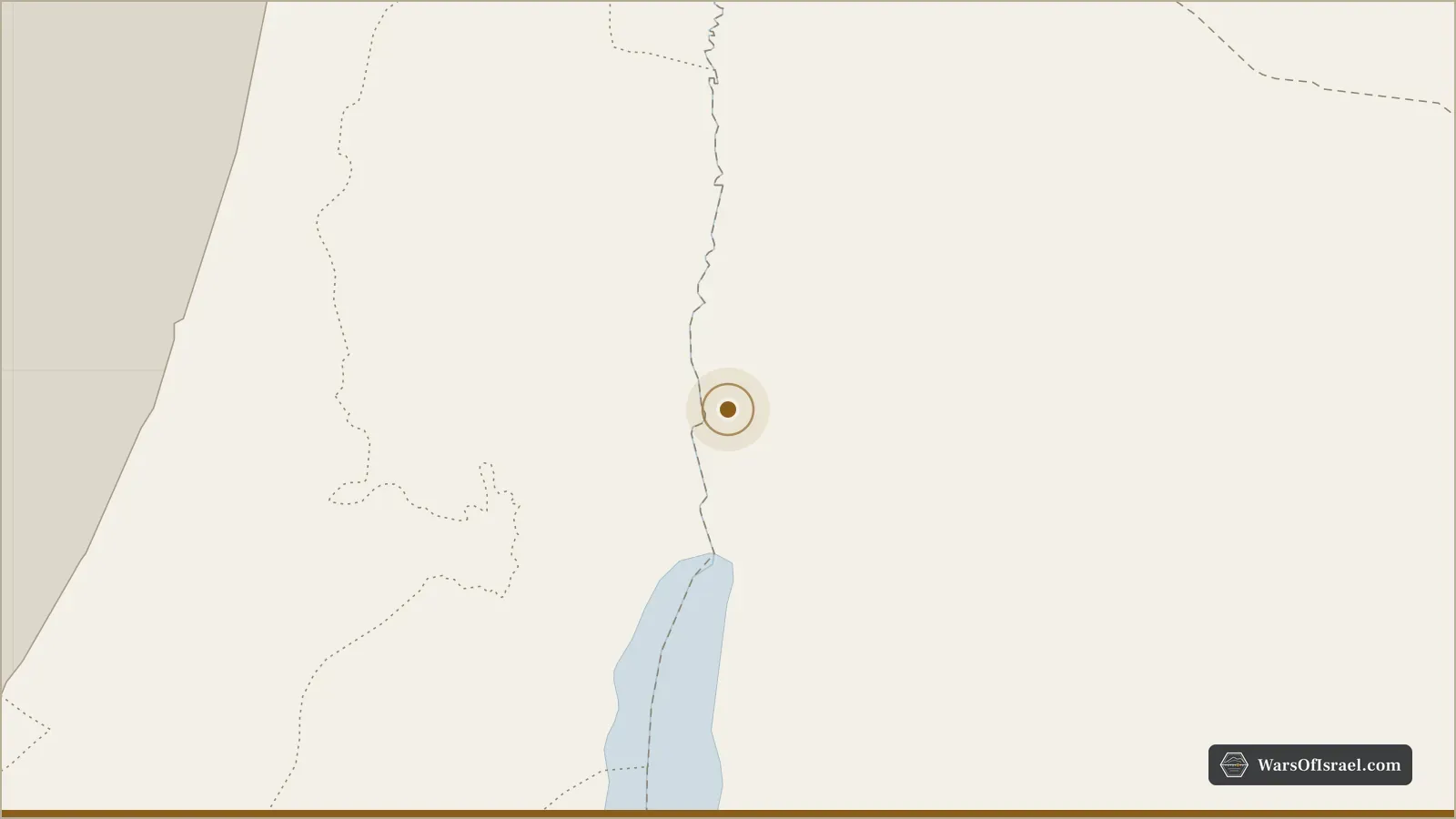
The battle of Karameh was a one-day Israeli raid into Jordan on March 21, 1968 that ended very differently from how it was planned. Israel set out to destroy the main Fatah base in the Jordan Valley, at the town of Karameh, and largely did so. But the Jordanian army joined the fight in strength, Israeli losses were the heaviest of any single action since the Six-Day War, and Fatah emerged with a story of resistance that transformed it from a small guerrilla group into the leading force in Palestinian politics. The battle is counted as part of the eastern front of the War of Attrition. In Hebrew it is known as Operation Tofet (Inferno).
A base across the river
After June 1967, Fatah and other Palestinian armed groups moved their operations to the East Bank of the Jordan. Karameh, a town of refugees a few kilometers east of the Allenby Bridge, became Fatah's main base, from which cells crossed the river to lay mines and attack Israeli targets. Through the winter of 1967 to 1968, such attacks multiplied.
The trigger came on March 18, 1968, when a school bus hit a mine near Be'er Ora, north of Eilat in the Arava. Two adults were killed and several children were wounded. The Israeli government approved a large raid. Jordan, which had received warnings through intermediaries, reinforced its positions, and Fatah, aware that an attack was coming, chose to stand and fight rather than withdraw.
The fighting on March 21
Before dawn on March 21, Israeli forces under the overall command of Uzi Narkiss, head of Central Command, crossed the Jordan at several points. Armored and paratroop units, supported by artillery and the air force, advanced on Karameh while helicopter-borne paratroopers landed to its east to block the escape routes. At the same time, a smaller force carried out Operation Asuta against guerrilla bases at Ghor es-Safi, south of the Dead Sea.
In Karameh itself, Israeli troops fought house to house against Fatah fighters and destroyed much of the camp. The harder fighting came at the river crossings and on the approaches, where the Jordanian 1st Infantry Division and its armor and artillery engaged the Israeli columns. Jordanian guns shelled the bridges, and Israeli armor met Jordanian tanks in several engagements. By the afternoon, the Israeli command ordered a withdrawal, which was completed under fire in the evening. Several damaged Israeli tanks and vehicles were left behind on the east bank, and Jordan later displayed them in Amman.
Losses
Casualty figures vary by source and are best given as ranges:
- Israel: between 28 dead (Chaim Herzog) and 33 dead (Benny Morris), with about 70 to more than 160 wounded depending on the count.
- Jordan: about 84 soldiers killed and some 250 wounded, according to the figures cited by Zeev Maoz and Benny Morris.
- Palestinian fighters: estimates range from about 100 to about 200 killed, and from about 100 to about 150 captured, in the accounts of Herzog, Morris and others.
The figures come from the works listed in this article's sources.
A military raid and a political legend
In narrow military terms, Israel achieved its main objective: the Fatah base was destroyed and many of its fighters killed or captured. Yet the price, the abandoned vehicles and the image of an Arab force holding its ground only nine months after June 1967 made the battle look very different in Amman and in the refugee camps. Karameh means "dignity" in Arabic, and Fatah made the most of the name. Yasser Arafat, who was at Karameh, became the face of the Palestinian armed movement, and Fatah reported thousands of new volunteers in the days that followed.
Historians describe the outcome as a split verdict: a tactical Israeli success and a political and symbolic victory for Fatah and for Jordan, which credits its army with stopping the Israeli advance. In Israel, the losses prompted questions about intelligence and planning, and the IDF shifted toward smaller, more precise raids and helicopter-borne operations, a pattern visible later in the Beirut airport raid. The growth of the armed groups in Jordan after Karameh also set them on a collision course with King Hussein, which ended in the Jordanian civil war of September 1970.