AttackSix-Day War to Yom KippurReference entry
The Munich Olympics massacre (1972)
What happened in the Olympic Village and at Fürstenfeldbruck on September 5 and 6, 1972, who the eleven Israeli victims were, and how Germany and Israel have reckoned with the attack since.
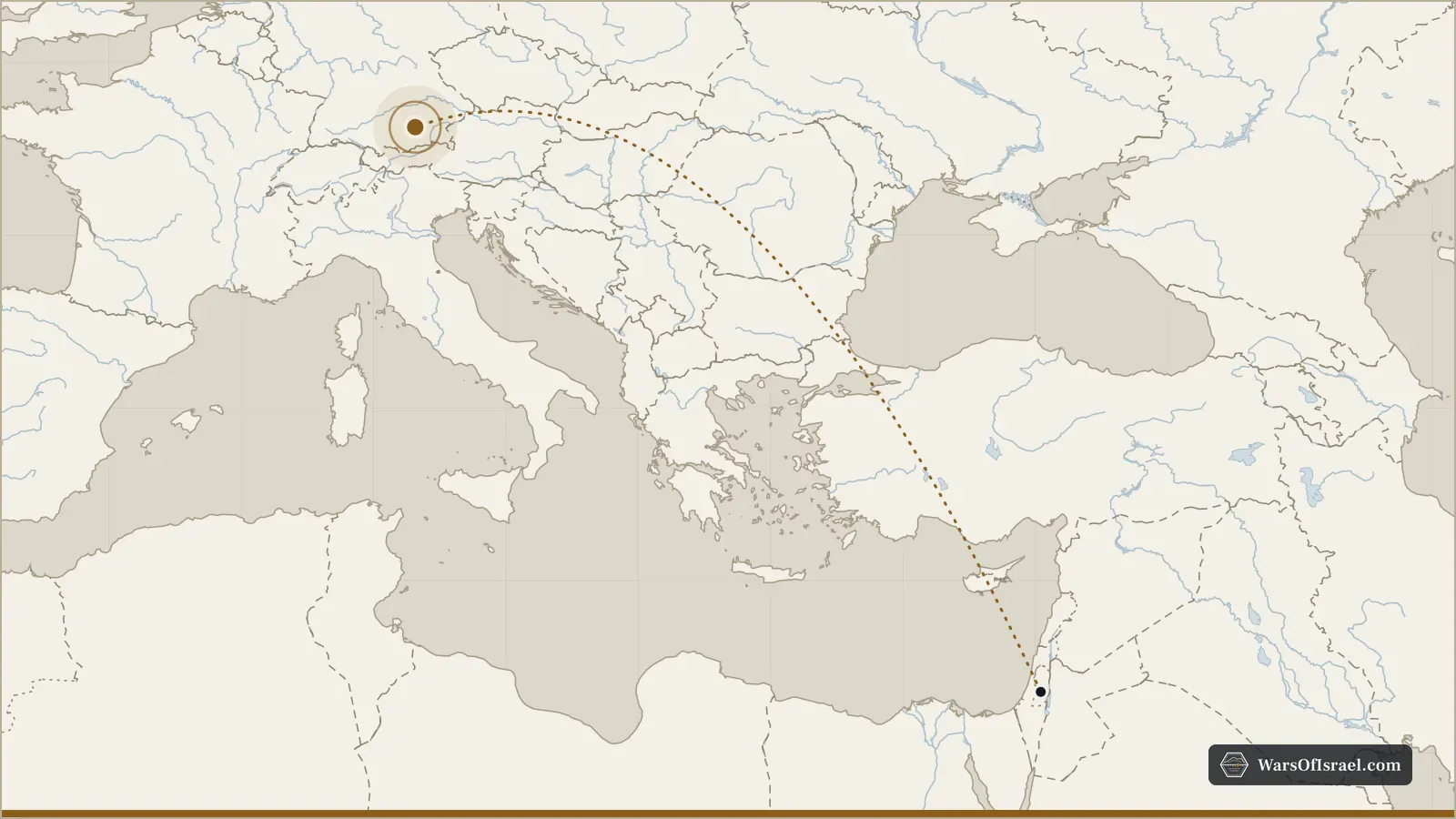
The Munich massacre was the attack by the Palestinian group Black September on the Israeli team at the 1972 Summer Olympics in Munich, West Germany. In the early hours of September 5, 1972, eight members of the group broke into the team's quarters in the Olympic Village, killed two Israelis and took nine hostage. That night, a West German police attempt to free the hostages at the Fürstenfeldbruck air base failed, and all nine were killed. Eleven Israeli athletes, coaches and officials died in all, along with a West German police officer. The attack made terrorism a global television event and shaped Israeli security policy for years. It was carried out abroad, but it belongs to the same wave of attacks as the Sabena hijacking four months earlier.
The attack in the Olympic Village
The Games had been presented as a symbol of a new, democratic Germany, and security in the village was deliberately light. At about 4:30 a.m. on September 5, the attackers, carrying weapons in sports bags, climbed the perimeter fence and entered the building at Connollystraße 31, where the Israeli delegation was housed. Wrestling coach Moshe Weinberg and weightlifter Yossef Romano tried to resist and were killed. Several team members escaped; nine were taken hostage.
The attackers demanded the release of hundreds of prisoners, most of them Palestinians held in Israel, along with safe passage out of Germany. Prime Minister Golda Meir's government refused to negotiate over the prisoners, a position it said was essential to prevent further attacks. Through the day, the West German and Bavarian authorities negotiated with the attackers, while millions of people watched the building on live television.
The failed rescue at Fürstenfeldbruck
In the evening, the attackers and their hostages were flown by helicopter to Fürstenfeldbruck, a military airfield west of Munich, where they expected a plane to take them to Cairo. The German authorities had instead prepared an ambush. It was badly flawed: there were too few marksmen, they lacked proper equipment and communication, and a team of police officers who were to pose as the aircraft crew abandoned the plan shortly before the helicopters landed.
The helicopters landed just after 10:30 p.m., and the gunfight that followed went on for more than an hour. In its final stage, the attackers killed all nine hostages. Five of the attackers and the West German police officer Anton Fliegerbauer were also killed; three attackers were captured. Mossad chief Zvi Zamir, who had flown to Germany, watched the failed rescue from the airfield.
The eleven Israelis killed were Moshe Weinberg, Yossef Romano, Ze'ev Friedman, David Berger, Yakov Springer, Eliezer Halfin, Yossef Gutfreund, Kehat Shorr, Mark Slavin, Andre Spitzer and Amitzur Shapira.
Aftermath and memory
A memorial service was held in the Olympic stadium on September 6, and International Olympic Committee president Avery Brundage declared that "the Games must go on". On September 8, Israeli aircraft struck PLO bases in Syria and Lebanon. On October 29, 1972, Palestinian hijackers seized a Lufthansa airliner and demanded the release of the three captured attackers, and West Germany freed them the same day, a decision that Israel and the victims' families strongly condemned.
The Israeli government then authorized a covert campaign, widely known as Operation Wrath of God, in which the Mossad killed a series of Palestinian figures it linked to Black September and the attack. One of the most prominent operations of that period was Operation Spring of Youth in Beirut in April 1973. The campaign also led to the killing of an innocent Moroccan man, Ahmed Bouchiki, in Lillehammer, Norway, in July 1973.
For decades, the victims' families sought full disclosure of the German failures and adequate compensation. In 2004 they reached a settlement of 3 million euros with the German government, which many of them regarded as inadequate. On September 5, 2022, at a ceremony at Fürstenfeldbruck attended by Israeli President Isaac Herzog, German President Frank-Walter Steinmeier asked the families for forgiveness for the failures of the German state, after an agreement in which Germany raised its total compensation to 28 million euros and agreed to open its archives to a joint commission of German and Israeli historians. The International Olympic Committee held a minute of silence for the victims at an Olympic opening ceremony for the first time at the Tokyo Games, in 2021.