Military operationLebanon and the first intifadaReference entry
Operation Accountability (1993)
How a week of Israeli bombardment in southern Lebanon tried to turn the population against Hezbollah, and how it ended in an unwritten deal that shaped the next seven years.
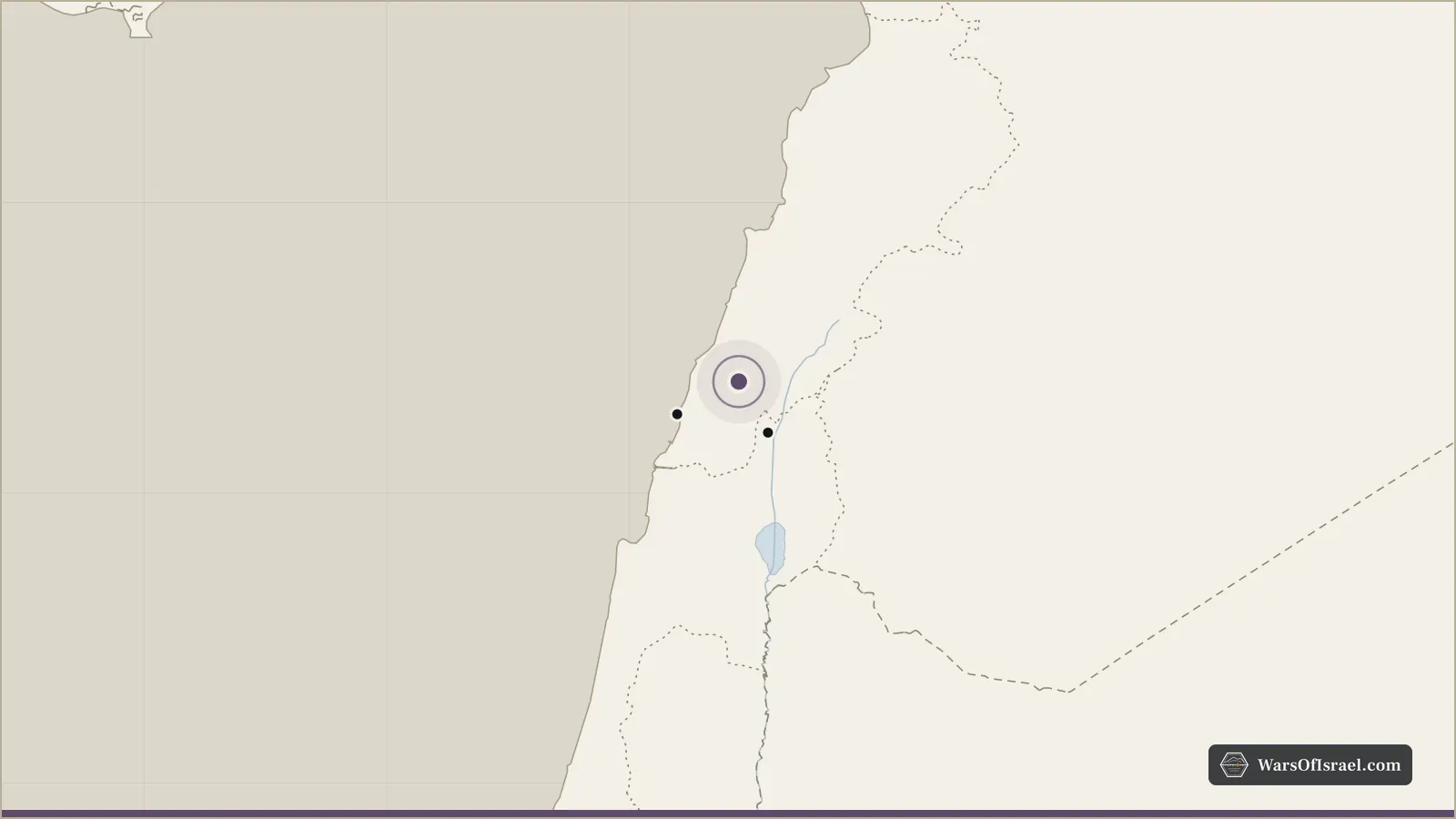
Operation Accountability (in Hebrew, Mivtza Din VeHeshbon) was a seven-day Israeli air, artillery and naval bombardment of southern Lebanon, from July 25 to July 31, 1993. Its declared purpose was to stop Hezbollah's attacks on Israeli soldiers in the security zone and its rocket fire on northern Israel. Its method was unusual: by striking villages and driving their residents north, Israel sought to put pressure on the Lebanese government and on Syria to rein in Hezbollah. It ended with an unwritten understanding brokered by the United States, which did not disarm Hezbollah but did set the rules of the conflict in southern Lebanon for the following years.
Background: escalation in the security zone
By the summer of 1993 the war in the South Lebanon security zone had entered a more violent phase. Since the killing of Hezbollah's secretary general, Abbas al-Musawi, by Israeli helicopters in February 1992, attacks on Israeli and South Lebanon Army positions had grown more frequent and more effective, and Hezbollah had repeatedly fired Katyusha rockets at towns in the Galilee in response to Israeli strikes that killed Lebanese civilians.
In July 1993 the pressure peaked. In the first weeks of the month Hezbollah and the Popular Front for the Liberation of Palestine, General Command, killed several Israeli soldiers in attacks in and near the zone, and Hezbollah fired rockets into northern Israel. The government of Yitzhak Rabin, who also served as defense minister, decided that a limited response was no longer enough.
The operation
The IDF opened fire on July 25, 1993. For a week, the Israeli Air Force struck targets across southern Lebanon and as far as the Bekaa Valley, while artillery shelled villages in the south and navy vessels fired on the coast. Before and during the bombardment, the army broadcast warnings telling residents of dozens of villages to leave. Israeli officials explained the purpose openly: a mass flow of refugees toward Beirut would push the Lebanese government, and behind it Syria, to act against Hezbollah.
The displacement was enormous. According to Human Rights Watch, the offensive temporarily displaced some 300,000 Lebanese villagers and Palestinian refugees. Human Rights Watch counted some 120 Lebanese civilians killed and close to 500 injured during the week, and estimated that about 1,000 houses were destroyed. Hezbollah went on firing rockets into Israel throughout the operation. According to Human Rights Watch, those rockets killed two Israeli civilians and injured 24.
Figures for Hezbollah's own losses are disputed. Israeli officials said dozens of fighters had been killed; Lebanese officials put the number far lower. No independent count exists.
The July 1993 understandings
The fighting ended on July 31, 1993, after American mediation led by Secretary of State Warren Christopher, working through Damascus and Beirut. The arrangement was never written down. Its core, as described by Human Rights Watch and by Israeli researchers such as Daniel Sobelman, was that Hezbollah would stop firing rockets into northern Israel and Israel would refrain from attacking civilians and civilian targets in Lebanon. The understanding said nothing about attacks on Israeli and SLA forces inside the security zone, which Hezbollah continued.
Human Rights Watch later described the understandings as inherently unstable. Each side drew its own red line, Israel at Katyusha fire on its towns and Hezbollah at Israeli or SLA strikes on Lebanese civilians, and each kept the right to retaliate when it judged that the other side had crossed it. Civilians on both sides of the border became, in effect, the guarantee of the arrangement.
Outcome and significance
In the short term the operation brought quiet to the Galilee. Within weeks, however, the war in the zone resumed: on August 19, 1993, Hezbollah killed seven Israeli soldiers in an ambush in southern Lebanon. The operation had not weakened Hezbollah, and the Lebanese government had not turned against it. If anything, Hezbollah's social and reconstruction networks gained standing in the south as they helped rebuild damaged homes.
The most lasting result was the arrangement itself. For the first time, Israel had accepted, even if only tacitly, a framework that treated the fighting inside the security zone as a separate arena from attacks on civilians. When that framework broke down again in 1996, Israel launched a larger and longer campaign, Operation Grapes of Wrath, which ended with a written version of the same rules. The pattern of a short bombardment followed by an unwritten or loosely written ceasefire returned in later rounds, up to the Second Lebanon War. Human Rights Watch's report Civilian Pawns (opens in a new tab) remains the most detailed independent account of the operation's toll.