Military operationLebanon and the first intifadaReference entry
Operation Grapes of Wrath (1996)
How a campaign meant to stop Hezbollah's rockets became defined by the shelling of the UN compound at Qana, and how it ended in a written set of rules for the Lebanese front.
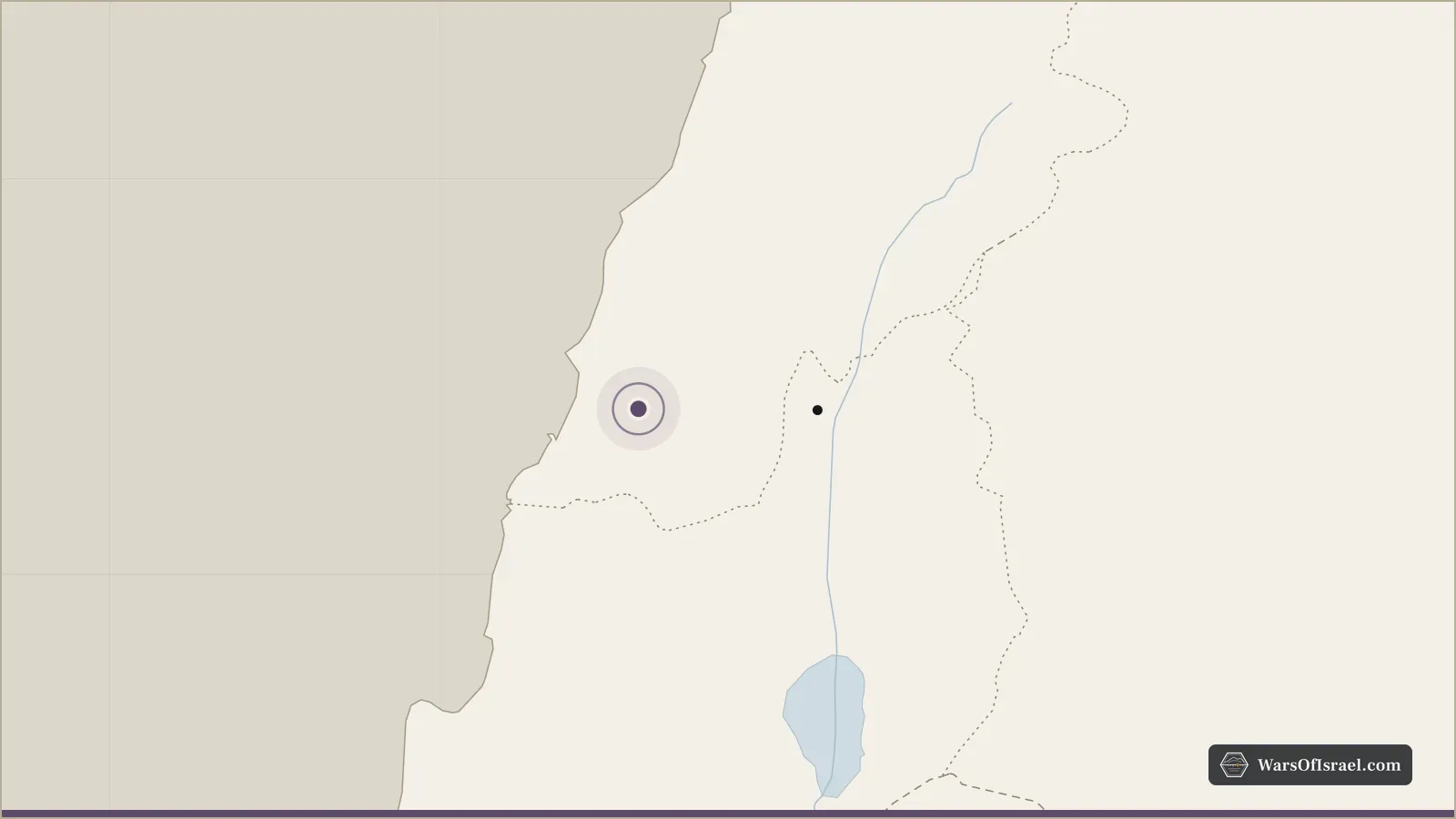
Operation Grapes of Wrath (in Hebrew, Mivtza Invei Za'am) was a seventeen-day Israeli air and artillery campaign against Hezbollah in Lebanon, from April 11 to April 27, 1996. Israel launched it to stop rocket fire on the Galilee, which had resumed in breach of the understandings that ended Operation Accountability in 1993. It is remembered above all for a single event: on April 18, Israeli artillery shells struck the compound of the UN peacekeeping force at Qana, where hundreds of villagers had taken shelter, killing about a hundred of them. The operation ended with the April Understanding, a written set of rules that governed the Lebanese front until Israel left the security zone in 2000.
Background: the 1993 rules break down
The unwritten understandings of July 1993 had separated two kinds of fighting: attacks on Israeli and South Lebanon Army forces inside the security zone, which went on, and attacks on civilians on either side of the border, which both sides had undertaken to avoid. By early 1996 that separation was failing. The immediate trigger was Hezbollah rocket fire on the Galilee that wounded Israeli civilians, after weeks of mutual accusations over the killing of civilians in southern Lebanon.
The timing also had a political dimension. Shimon Peres had become prime minister after the assassination of Yitzhak Rabin in November 1995, and he faced an election on May 29, 1996, after a wave of Hamas suicide bombings in Israel in February and March. Critics argued that electoral pressure shaped the response; the government said it was protecting the north.
The operation
The IDF began with air strikes in southern Lebanon, the Bekaa Valley and the southern suburbs of Beirut, and with artillery fire on villages across the south. As in 1993, warnings told residents of dozens of villages to leave, and hundreds of thousands fled north. Israeli warplanes also struck a power station near Beirut.
According to Human Rights Watch, Israeli artillery fired some 25,000 shells into Lebanon during the operation, and Hezbollah fired 639 Katyusha rockets into Israel. The rockets wounded civilians and, according to Human Rights Watch, forced the displacement of tens of thousands of residents of northern Israel; many who stayed spent the operation in shelters.
Qana, April 18, 1996
On April 18, after Hezbollah fighters fired mortars and rockets from a site a few hundred meters from the UNIFIL compound at Qana, an Israeli artillery battery fired in response. More than 800 Lebanese civilians were sheltering in the compound. According to the report of the UN Secretary-General's military adviser, Major General Franklin van Kappen of the Netherlands, about a hundred of them were killed and many more were wounded, as were four UN soldiers.
Israel said the shelling was a tragic mistake: its gunners had been firing at the Hezbollah crew, and some rounds had fallen on the compound. The UN report, submitted on May 7, 1996, concluded that while the possibility could not be ruled out completely, it was "unlikely" that the shelling of the compound was the result of gross technical or procedural errors. It found the pattern of impacts inconsistent with the Israeli account, and noted an Israeli drone in the area, which Israel had first denied. Israel rejected the report's conclusions. The UN report on the shelling of Qana (opens in a new tab) is the main official document on the incident.
The April Understanding
The shelling of Qana turned the operation into an international crisis. American mediation, led by Secretary of State Warren Christopher, with France and Syria also involved, produced the April Understanding, which took effect at 4:00 a.m. on April 27, 1996. Unlike the 1993 arrangement, it was written down. It barred attacks on civilians and civilian targets on both sides of the border and the use of civilian areas as launching sites, while leaving both sides free to act in self-defense. A Monitoring Group of the United States, France, Syria, Lebanon and Israel was set up to examine complaints.
Outcome and significance
According to Human Rights Watch, some 154 Lebanese civilians were killed during the operation and 351 were injured. Human Rights Watch recorded no Israeli deaths from the rocket fire during the operation. Hezbollah was not disarmed, and its standing in Lebanon rose.
In military terms the operation achieved a temporary quiet in the Galilee, but it left Hezbollah's freedom to attack Israeli troops inside the zone untouched, and the written rules arguably confirmed it. In political terms it was costly for Israel: Qana became a symbol in Lebanon and the Arab world, and many analysts of the May 1996 election believe that anger over the operation among Arab citizens of Israel contributed to Peres's narrow defeat by Benjamin Netanyahu. In 2006, during the Second Lebanon War, an Israeli strike in Qana again killed civilians.