BattleSix-Day War to Yom KippurReference entry
The Sinai tank battle of October 14 (1973)
The largest Egyptian offensive of the Yom Kippur War, its defeat in a single day and the decision it made possible: Israel's crossing of the Suez Canal.
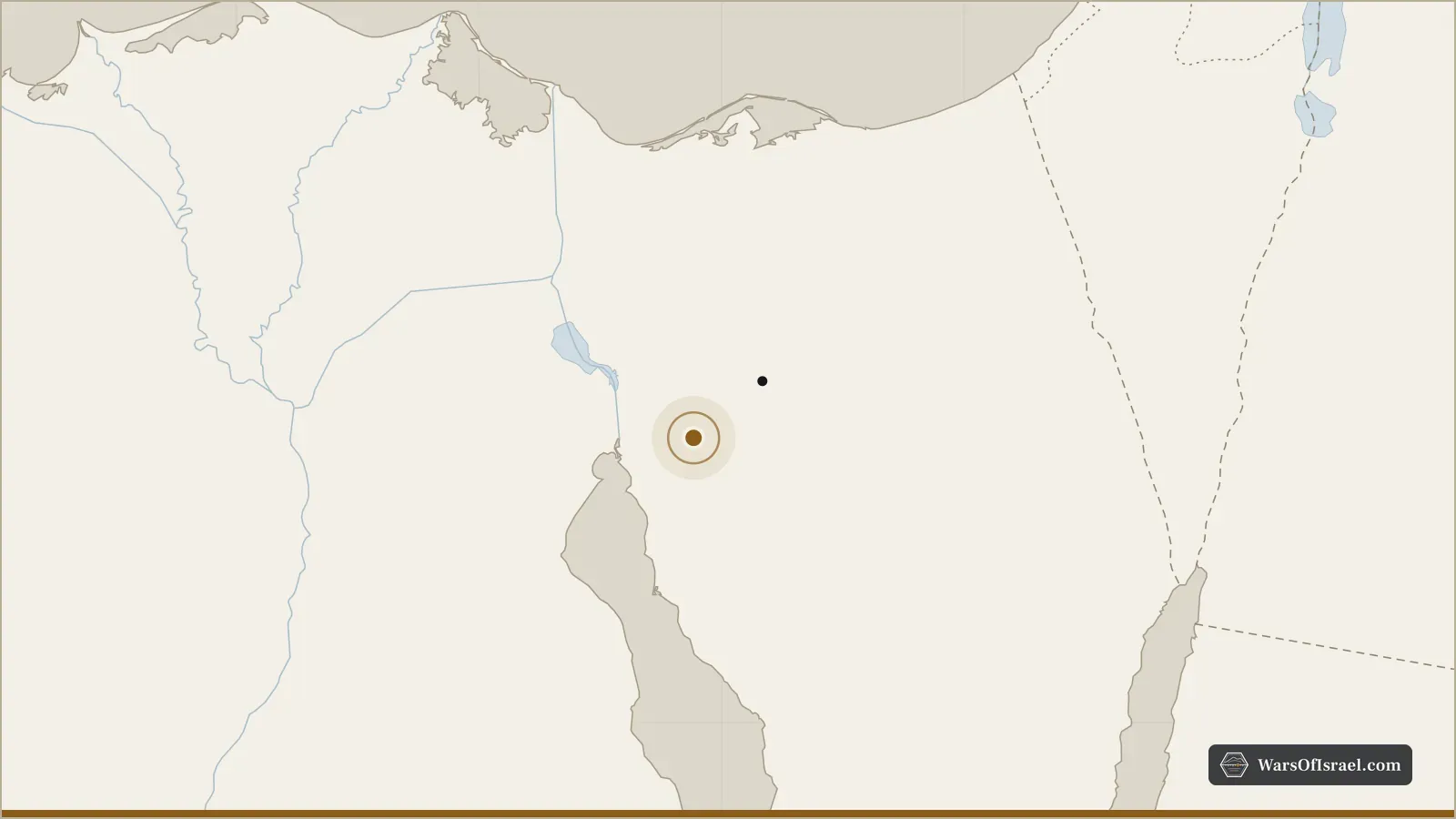
On October 14, 1973, the ninth day of the Yom Kippur War, Egypt launched its largest offensive of the war in Sinai, sending armored and mechanized brigades east from its bridgeheads on the Suez Canal toward the Gidi and Mitla passes and the central routes into the peninsula. Israeli forces waiting in prepared positions defeated the attack within hours. It was one of the largest armored battles since the Second World War, and its result changed the war: Egypt's armored reserve was badly weakened, and the next night Israel began its crossing of the canal.
Background: a decision forced by Syria
In the first week of the war the Egyptian army had achieved what it planned. It had crossed the canal on October 6, broken the Bar-Lev Line, held off Israeli counterattacks and dug in along a strip of the east bank under the cover of its surface-to-air missile batteries. The Egyptian chief of staff, Saad el-Shazly, argued that the army should stay under that cover, where the Israeli Air Force could not attack it freely.
On the Golan front, however, Syria was in retreat, and from October 11 Israeli forces were advancing into Syria. Damascus asked Cairo for an offensive that would force Israel to move forces south. President Sadat ordered the attack; according to Shazly's memoir, both he and the war minister, Ahmad Ismail Ali, opposed it. The plan sent four armored brigades and a mechanized brigade in four separate thrusts, with parts of the 4th and 21st Armored Divisions brought across from the west bank. Moving them east of the canal left the Egyptian reserve on the west bank thin, a fact that would matter within days.
The battle
The attack began early in the morning of October 14 after an artillery bombardment. On the Israeli side, the divisions of Avraham Adan, Ariel Sharon and Kalman Magen, who had taken over the southern division after Albert Mandler was killed on October 13, were waiting in prepared positions on the high ground, with tanks in hull-down positions and infantry with anti-tank missiles, including newly arrived American TOW missiles. Because the Egyptian columns had moved beyond their missile umbrella, the Israeli Air Force could attack them.
The Egyptian thrusts were stopped one after another. In the south an Egyptian armored brigade advancing through Wadi Mabouk toward the Mitla Pass was largely destroyed. In the north, near the road to Tasa and Baluza, Egyptian columns ran into the positions of Adan's and Sharon's divisions and were driven back with heavy losses. By the afternoon the Egyptian forces were withdrawing to their bridgeheads.
Figures for the losses vary. Israeli estimates, repeated in most Western accounts, put Egyptian losses at about 200 to 250 tanks destroyed or abandoned; Egyptian sources give lower figures. Israeli tank losses were much smaller, according to most estimates a few dozen, many of them repaired.
Outcome and significance
The offensive failed to relieve Syria and weakened the Egyptian armored reserve. That evening Chief of Staff David Elazar presented the plan for crossing the canal to the cabinet, and the crossing, Operation Abirey-Halev, began the next night. The Egyptian armor that had crossed east was then partly caught up in the fighting at the Chinese Farm. In Israel the battle is remembered as the moment the war in Sinai turned; Egyptian historians, Shazly among them, have treated it as the main strategic error of the Egyptian conduct of the war.