BattleSix-Day War to Yom Kippur
The battle of the Chinese Farm (1973)
Three days of fighting, from October 15 to 17, 1973, for the roads that led to Israel's crossing point on the Suez Canal, and why the battle is remembered as one of the hardest of the war.
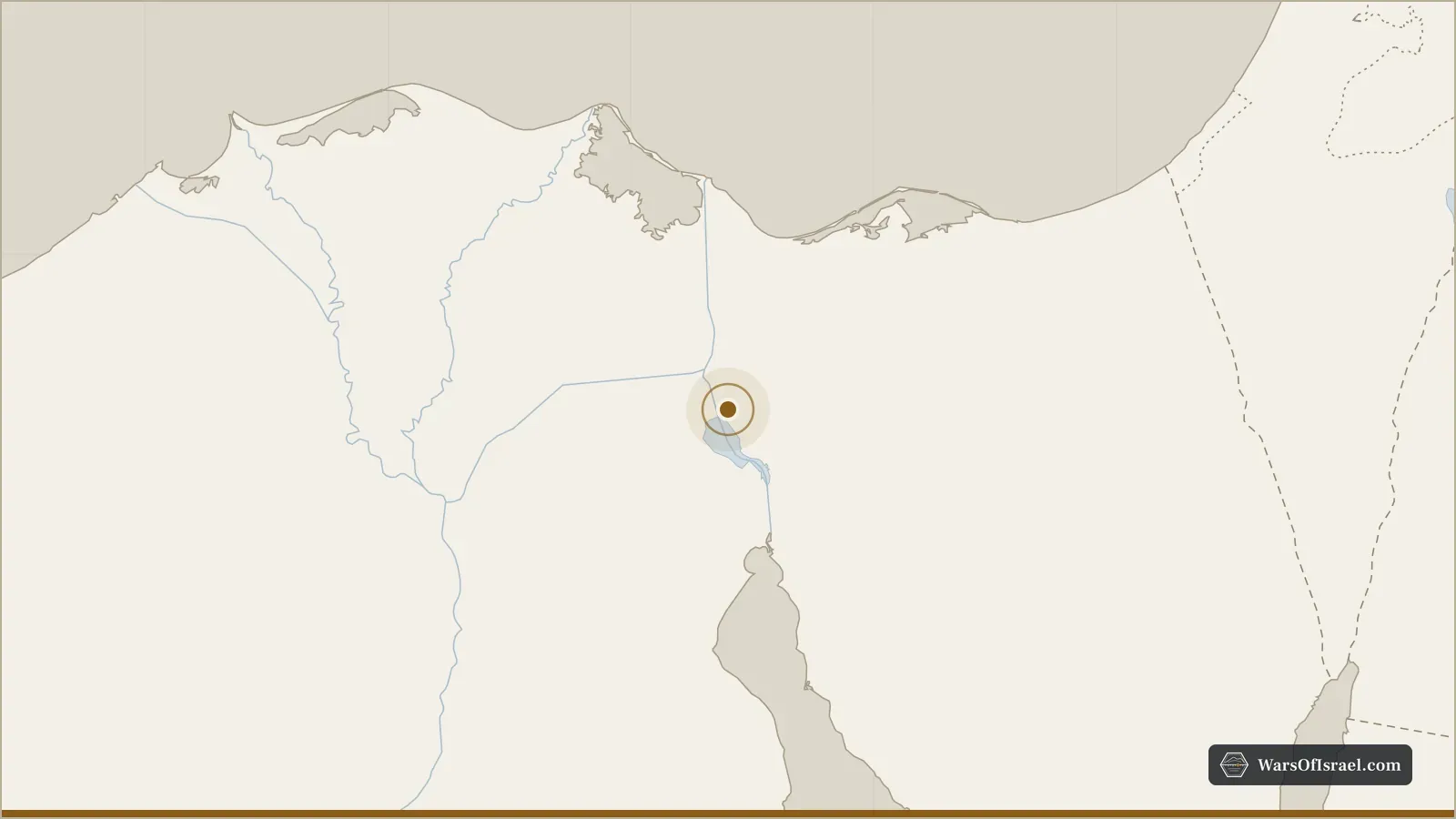
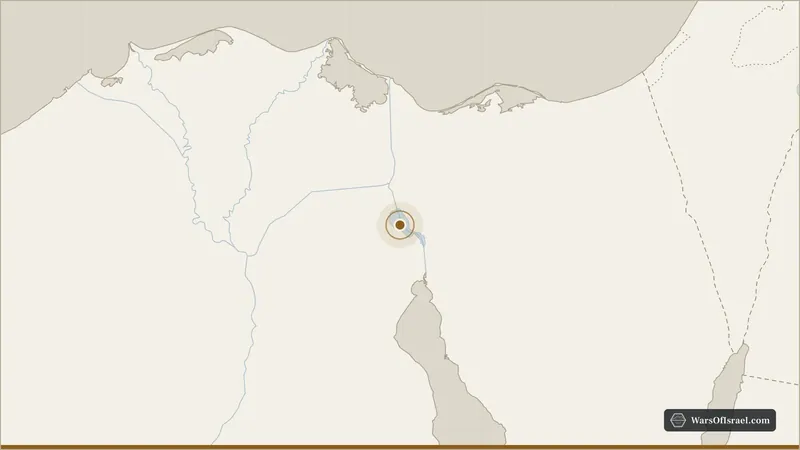
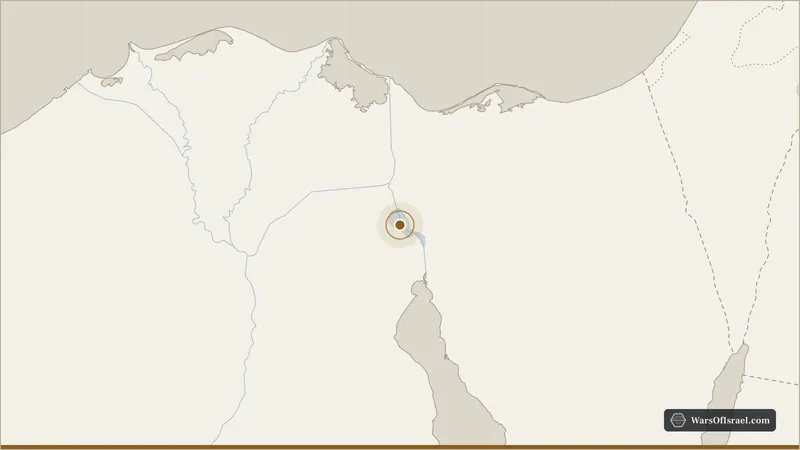
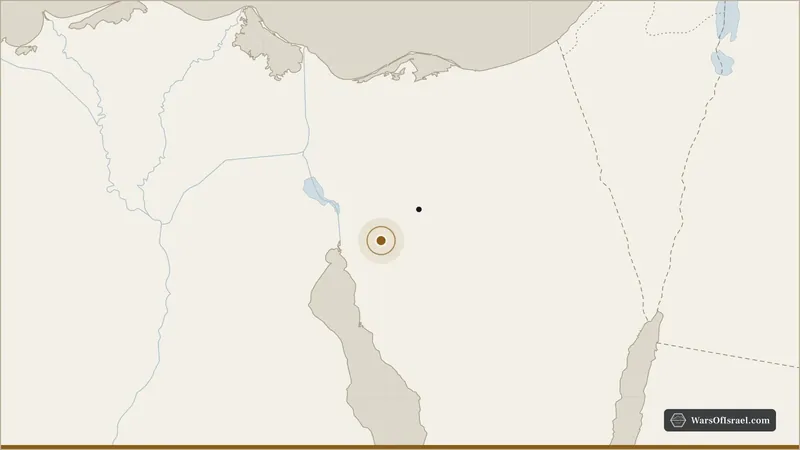
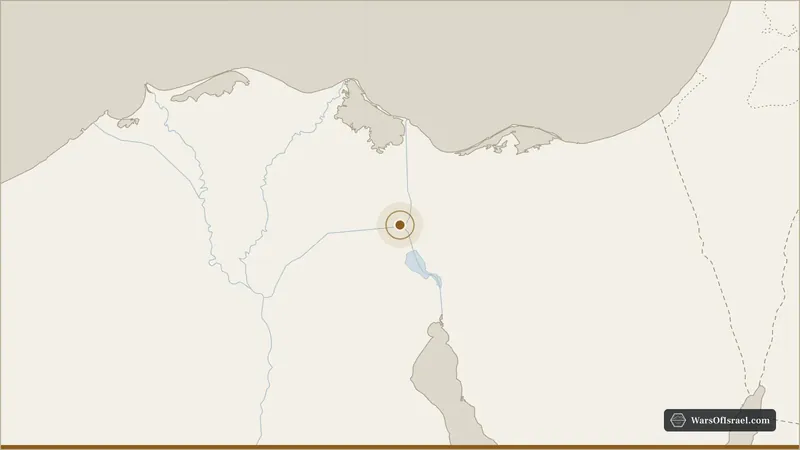
The battle of the Chinese Farm was fought from October 15 to 17, 1973, on the east bank of the Suez Canal, just north of the Great Bitter Lake, during the Yom Kippur War. Its object was not the farm itself but the two roads that ran past it, Akavish and Tirtur, which Israel needed to bring bridges to its crossing point at Deversoir in Operation Abirey-Halev. Egyptian infantry and armor of the 16th Infantry Division and the 21st Armored Division held the area in strength, and three nights and two days of close fighting, in which Israeli armored and paratroop units took heavy losses, were needed before the roads were open and the first bridge reached the water. According to the usual explanation, the name came from Japanese writing on equipment at the station, which Israeli soldiers in 1967 took for Chinese.
The ground and the stakes
Before 1967 the area had been an Egyptian agricultural research station, irrigated from the canal and laid out with drainage ditches and embankments. After the Six-Day War it was abandoned, and in October 1973 its ditches made ready-made trenches. The Egyptian 16th Infantry Division, part of the Second Army, held the southern end of the Second Army bridgehead here, and the 21st Armored Division, which had taken part in the failed offensive of October 14, was concentrated in the same area.
For the Israeli crossing, this was the single most important piece of ground in Sinai. Akavish ran west from the Israeli rear and Tirtur ran parallel to it to the north, both ending at the crossing yard near Deversoir. The crossing could start without the roads, by boat, but it could not be sustained: the pontoons and the roller bridge, the fuel and the ammunition all had to travel along them. As long as Egyptian forces could fire on Tirtur and Akavish from the farm, the bridgehead on the west bank was isolated.
The forces
The Israeli forces belonged first to Ariel Sharon's 143rd Division, whose task was to open the corridor and lay the bridges, and later to Avraham Adan's 162nd Division, which was brought in when Sharon's units could not finish the job. Sharon's main striking force was the 14th Armored Brigade under Colonel Amnon Reshef, which started the battle with 97 tanks according to published Israeli accounts, reinforced by infantry and reconnaissance units. On October 16 and 17 a paratroop brigade under Colonel Uzi Ya'iri, including a battalion under Lieutenant Colonel Yitzhak Mordechai, was sent to clear the Egyptian infantry along Tirtur.
On the Egyptian side the 16th Infantry Division under Brigadier General Abd Rab el-Nabi Hafez held the positions, with the 21st Armored Division under Brigadier General Ibrahim Oraby close by. Egyptian infantry were armed with Sagger missiles and RPGs, well dug in, and supported by artillery from the west bank. Neither side expected, on the evening of October 15, to meet the other at such close range.
Three nights of fighting
October 15 to 16: Reshef's brigade
Reshef's brigade moved south and west around the Egyptian flank in the evening of October 15, reached the canal near the abandoned Matzmed and Lakekan strongpoints without opposition, and then turned north to clear the roads. In the dark it ran into the administrative and logistics area of the Egyptian divisions, packed with vehicles, and then into their main positions. The fighting through the night was at extremely short range, often among parked vehicles and irrigation ditches, with tanks of both sides mixed together. According to the same accounts, Reshef lost 56 of his 97 tanks within about twelve hours, and by the following noon had 27 still in action. Several company and battalion commanders were killed.
At the same time, a few kilometers to the south, the paratroopers of Danny Matt's brigade were crossing the canal by boat. The crossing succeeded largely because the Egyptian commanders' attention was fixed on the battle at the farm.
October 16: deadlock
Through October 16 repeated Israeli attacks on the junction of Lexicon and Tirtur, at the heart of the Egyptian positions, failed. Reshef's brigade took the junction for a time and then withdrew to regroup. The roller bridge, which had to move on Tirtur, broke down; the pontoon convoy waited in the rear. In the Israeli command the argument between Sharon and his superiors over whether to push more forces to the west bank or first to clear the corridor became bitter.
October 16 to 17: the paratroopers on Tirtur
Late on October 16 Ya'iri's paratroopers were brought by helicopter and truck and sent along Tirtur at night with little preparation and little intelligence on the Egyptian positions. In the early hours of October 17 they were pinned down by Egyptian infantry fire at close range. They fought for about 14 hours before tanks covered their withdrawal. Their losses were heavy; published estimates for the paratroopers alone run to about 40 to 70 killed and about 100 wounded. The battle nonetheless drew Egyptian attention and fire away from Akavish, along which Adan's division moved the pontoons to the canal during the night.
October 17: the armored battle
On October 17 the Egyptian 21st Armored Division counterattacked from the north against the corridor, and an Egyptian armored brigade advanced from the south along the shore of the Great Bitter Lake. Adan's tanks defeated both. During the night of October 17 to 18 the Egyptian 16th Division's positions astride Tirtur were abandoned, and the roads were open. The first bridge had already been laid late on October 17.
Losses
The battle was one of the costliest for both armies. Accounts based on Israeli and Egyptian sources, including the study by George Gawrych, put Israeli losses in Sharon's division during the night of October 15 to 16 alone at around 300 killed and 1,000 wounded; this figure is an estimate and Israeli official totals for the battle have not been published separately. Egyptian losses are also known only in part. According to Gawrych, the 21st Armored Division, which had 136 tanks when the battle began, had no more than about 40 left by October 18. The Egyptian 16th Division also lost most of the tanks attached to it.
After the battle, photographs of the battlefield covered with wrecked tanks and vehicles of both sides were published widely in Israel, and the images became part of how Israelis understood the price of the crossing.
Significance and debate
Militarily the battle allowed the crossing to succeed and, through it, the encirclement of the Egyptian Third Army. Historians on both sides also see it as the point at which the cost of the war for Israel became fully visible: a battle fought at night on poorly known ground, with brigades sent in piecemeal and no time for reconnaissance. Israeli critics have pointed to the haste with which the paratroopers were committed, and Ya'iri himself acknowledged that his force had gone into action too quickly. Egyptian accounts emphasize the tenacity of the 16th Division's infantry, who held their positions for three days against superior armor.
For the Israeli army the battle became a case study in what went wrong when units were thrown into a night battle without knowing what lay ahead, and in what could still be achieved by commanders who adapted. Adan's decision to move the pontoons along Akavish while the paratroopers fought on Tirtur, rather than wait for the whole corridor to be cleared, is often cited as the moment the crossing was saved. The battle also showed how far Egyptian infantry training had come since 1967: soldiers armed with portable missiles, dug into ditches, could stop tanks.
The farm is now in Egyptian territory. In Israel the battle is commemorated by the units that fought there, and the name "the Chinese Farm" remains one of the best-known in Israel's memory of 1973, alongside the Valley of Tears.
Timeline
- October 15, 1973: Reshef's brigade reaches the canal in the evening and turns north into the Egyptian positions at the Chinese Farm.
- October 16, 1973: Paratroopers cross the canal at about 1:35 a.m. while fighting at the farm continues; Israeli attacks on the Tirtur junction fail.
- October 17, 1973: Ya'iri's paratroopers are pinned down on Tirtur; Adan's tanks defeat Egyptian armored counterattacks and the first bridge is laid.
- October 18, 1973: The Egyptian positions along Tirtur are abandoned and the corridor to the crossing is open.