CampaignBritish MandateReference entry
The Jewish Brigade in the Second World War (1944 to 1945)
The only Jewish formation to fight Nazi Germany under its own flag, and a unit whose postwar work mattered as much as its weeks in combat.
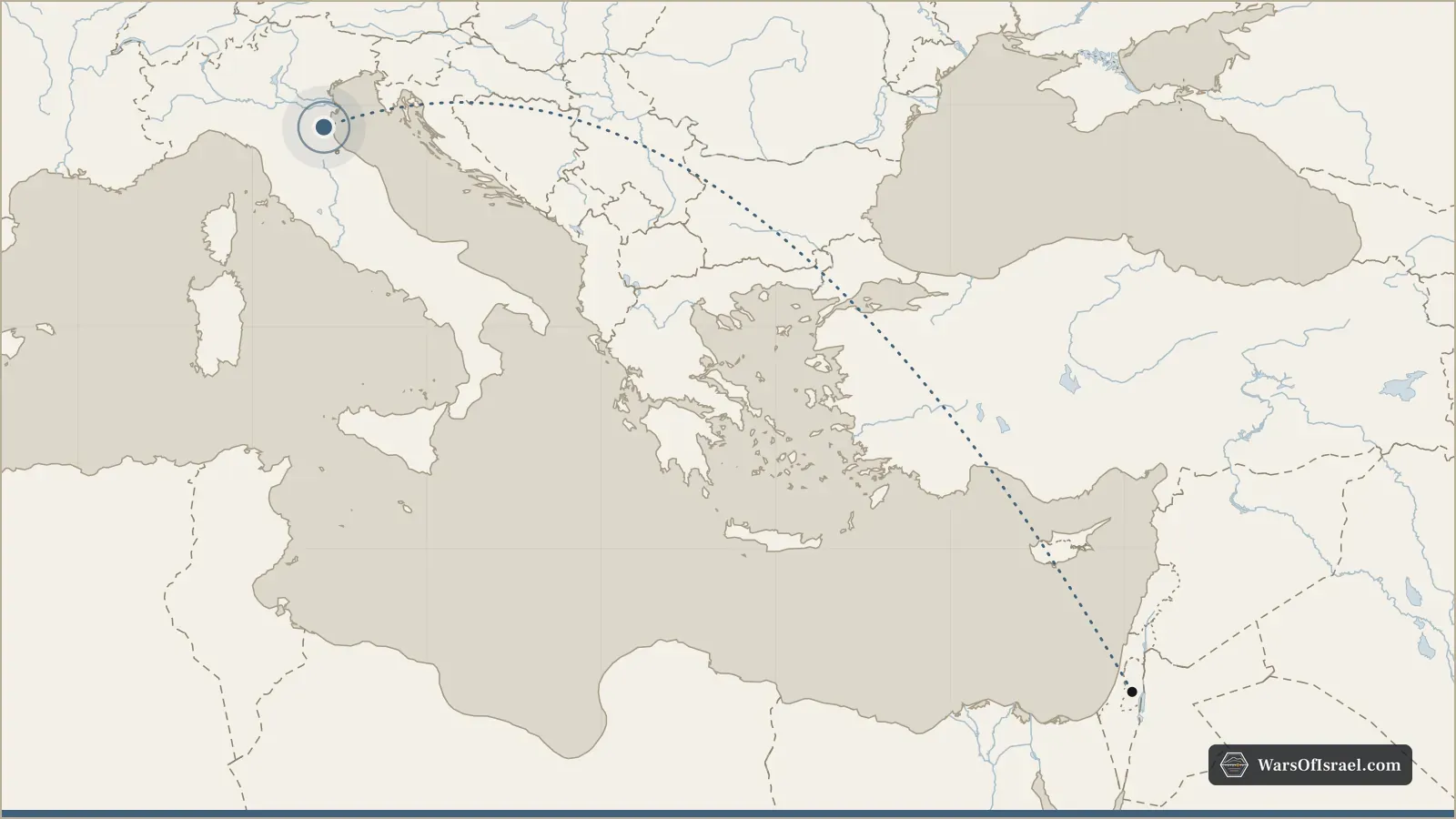
The Jewish Brigade Group was a British army formation of about 5,000 men, most of them Jewish volunteers from Mandatory Palestine, that fought against German forces in northern Italy in the spring of 1945. The War Office announced its formation on September 20, 1944, after years of pressure from the Zionist movement, and it went into the line on the Senio River in March 1945 under its own blue and white flag with the Star of David. Its time in combat was short, about seven weeks, but after the German surrender its soldiers became a lifeline for Holocaust survivors, and many of its officers went on to command units of the IDF.
Background: from volunteering to a Jewish formation
When the Second World War began, the Jewish Agency called on the Yishuv to enlist, and over the following years tens of thousands of Jews from Palestine served in the British forces, in Jewish companies of the Buffs, in the Palestine Regiment, in transport and engineering units and in the women's services. Chaim Weizmann and other Zionist leaders pressed throughout the war for a distinct Jewish fighting force, partly as a contribution to the war against Nazi Germany and partly as a political statement about the Jewish people's place among the Allies. The British government, wary of Arab reaction and of arming a future Jewish army, delayed the decision for years.
Winston Churchill supported the idea. In August 1944 the War Cabinet approved his proposal, he told Parliament of the decision, and on September 20, 1944 the War Office announced the formation of the Jewish Brigade Group. It was built around the three Jewish battalions of the Palestine Regiment, with the 200th Field Regiment of the Royal Artillery, an engineer company and support units, under Brigadier Ernest Benjamin, a Jewish officer of the British army.
Training, Italy and the Senio front
The brigade's headquarters was set up in Egypt at the end of September 1944, and its battalions trained there before landing at Taranto in southern Italy in November. After further training the brigade joined the British Eighth Army, and on March 3, 1945 it took over front-line positions on the Senio River, in the Alfonsine sector between Ravenna and the Apennine foothills, facing German troops dug in along the river embankments.
Its first major action came on the night of March 19 to 20, 1945, an assault near Alfonsine. In the Allied spring offensive of April 1945 the brigade crossed the Senio on April 10 and on April 12 captured the high ground of Monte Ghebbio. The infantry battalions were withdrawn from the line on April 15, after about seven weeks at the front, while support units remained in action until the end of the campaign. The war in Italy ended with the German surrender that came into effect on May 2, 1945.
Figures for the brigade's losses differ between sources and depend on whether non-combat deaths are included. Estimates of the dead range from about 30 to 83; several studies put the number killed in action at about 57, with about 150 to 200 wounded. Thirty-three of the brigade's dead are buried in the Ravenna War Cemetery of the Commonwealth War Graves Commission.
After the war: survivors, revenge and the road to Palestine
The brigade's most enduring contribution came after the fighting. Stationed in May 1945 near Tarvisio, close to the borders of Austria and Yugoslavia, its soldiers met the first survivors of the camps and organized help for them: food, clothing, shelter and the search for relatives. Brigade men worked with the Bricha, the clandestine movement that moved Jewish displaced persons across Europe toward the Mediterranean, and with the Mossad LeAliyah Bet, which ran the ships to Palestine. Historians estimate that the brigade helped move between 15,000 and 22,000 people.
A small group of its soldiers also carried out the killing of Nazi suspects in 1945, under cover of the brigade's movements. The numbers are uncertain and disputed, and the actions were never acknowledged by the brigade's command.
In July 1945 the British moved the brigade to Belgium and the Netherlands, partly to separate it from the survivors' routes. It was disbanded in the summer of 1946. Many of its veterans fought in the 1947 to 1949 war, bringing with them the organization and staff experience of a regular army, and several later became chiefs of staff or generals of the IDF, among them Mordechai Maklef, Haim Laskov and Israel Tal. In 2018 Italy awarded the brigade's war flag its Gold Medal of Military Valor, and in Israel the brigade is remembered as the first Jewish fighting formation of modern times, a direct link between the Jewish volunteers of the First World War and the army of the state.