The 1947 to 1949 war: Israel's War of Independence
From the partition vote to the last armistice line, the war that created the State of Israel, and the Palestinian refugee problem, in one connected account.
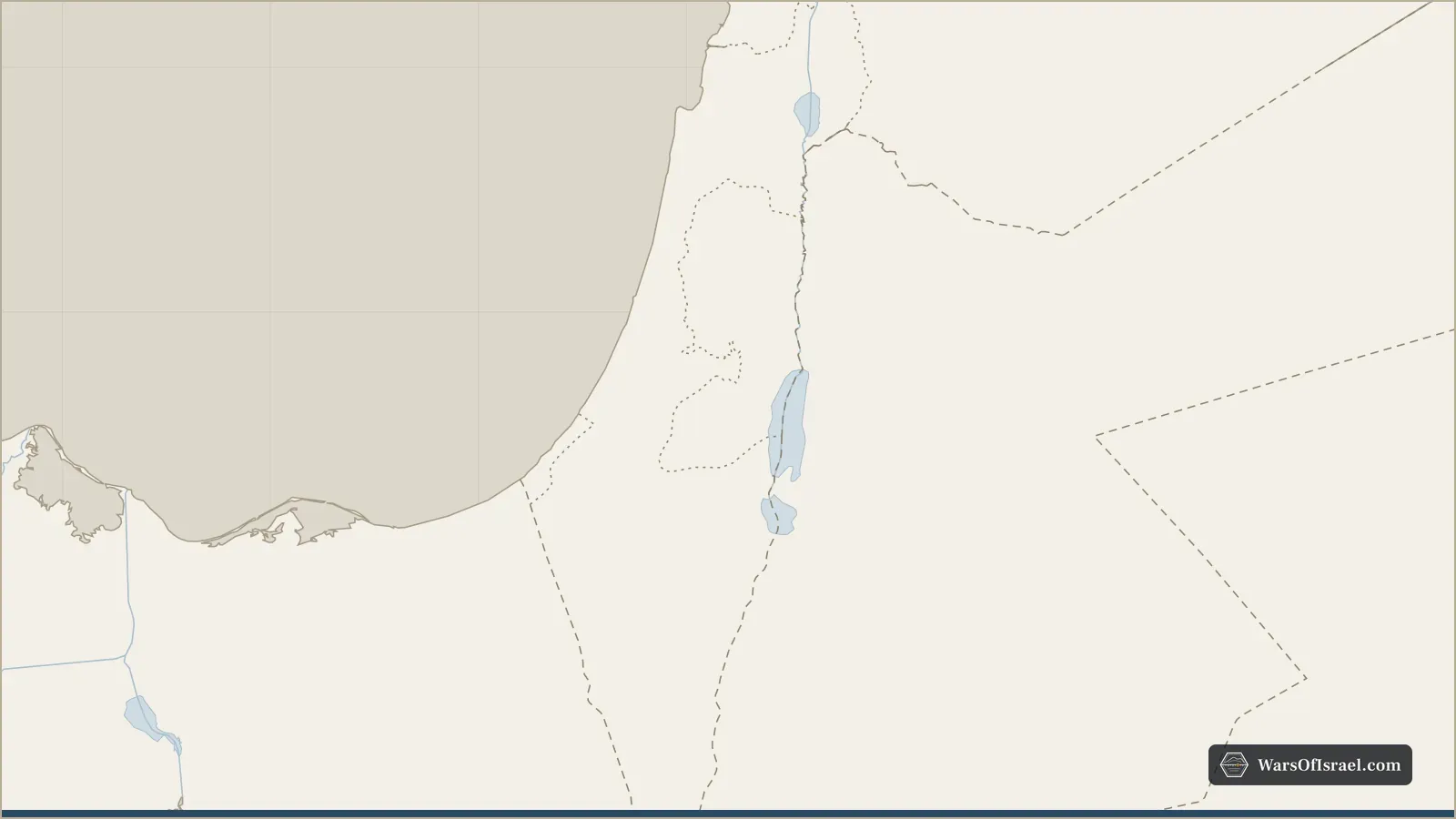
The war that Israelis call the War of Independence, and Palestinians call al-Nakba, the catastrophe, was really two wars fought back to back. The first began on November 30, 1947, the morning after the United Nations voted to partition Palestine, and pitted the Jewish community against Palestinian Arab fighters and volunteers while British troops were still in the country. The second began on May 15, 1948, the day after Israel declared independence, when the armies of Egypt, Transjordan, Syria and Iraq, with Lebanese forces, crossed the borders. By the time the last armistice was signed on July 20, 1949, Israel existed, held about 78 percent of Mandate Palestine, against the 56 percent the partition plan had allotted to the Jewish state, and roughly 700,000 Palestinian Arabs had fled or been expelled from their homes.
A country promised twice and governed by neither side
British rule in Palestine rested on the 1922 League of Nations Mandate, which committed Britain to a Jewish national home while protecting the rights of the Arab majority. Three decades of riots, a full Arab revolt from 1936 to 1939 and, after the Second World War, a Jewish armed campaign against British rule had left that formula in ruins. In February 1947 Britain handed the problem to the United Nations.
A UN special committee recommended partition. On November 29, 1947, the General Assembly adopted Resolution 181, the partition plan for Palestine (opens in a new tab), by 33 votes to 13 with 10 abstentions. It proposed a Jewish state, an Arab state and an international regime for Jerusalem and Bethlehem, bound together in an economic union. The Jewish Agency accepted the plan. The Arab Higher Committee and the Arab League rejected it, arguing that the UN had no right to divide a country against the will of its majority.
Britain announced that it would leave by May 15, 1948, and declined to implement a plan it had not endorsed. That decision shaped everything that followed. For five and a half months, two communities that were preparing for war lived side by side under a departing power that wanted to avoid casualties of its own.
The forces on each side
The Jewish community, the Yishuv, numbered about 650,000 people. Its main armed force was the Haganah, an underground militia linked to the Jewish Agency, with its full-time strike force, the Palmach. Two dissident groups, the Irgun and Lehi, operated separately and joined the national army only in stages. Historians estimate that the Haganah could mobilize about 35,000 people by the spring of 1948, though heavy weapons were scarce until arms bought in Czechoslovakia began arriving in April.
The Palestinian Arab community, about twice as large, had been badly weakened by the suppression of the 1936 revolt and had no unified army. Local militias and the Army of the Holy War of Abd al-Qadir al-Husayni, loyal to the exiled mufti Haj Amin al-Husseini, fought in the Jerusalem area. The Arab League created the Arab Liberation Army, a force of volunteers from neighboring countries under Fawzi al-Qawuqji, which began entering the country in January 1948.
After May 15 the balance changed. The Arab Legion of Transjordan, trained and commanded by British officers under John Bagot Glubb, was the best army in the region. Egypt sent the largest force. Historians' estimates of the invading armies' initial strength range from about 20,000 to 26,500 troops. On May 26, 1948, the provisional government ordered the formation of the Israel Defense Forces, which absorbed the Haganah and, more painfully, the Irgun. During the first truce, Israeli forces grew from about 35,000 to almost 65,000, and by the end of 1948 the army numbered close to 90,000, a mobilization of almost every adult man the Yishuv had.
The course of the war
The civil war, November 1947 to March 1948
On November 30, 1947, Arab gunmen attacked two Jewish buses near Petah Tikva and killed seven passengers. Within days the violence spread to Jerusalem, Haifa and the road network that tied the scattered Jewish settlements together. The early months were a war of ambushes, bombings and reprisals. Arab fighters attacked convoys on the roads, while the Irgun and Lehi set off bombs in Arab markets and the Haganah raided villages it accused of harboring attackers.
The roads were the Yishuv's weak point. Jerusalem, with about 100,000 Jews, depended on a single highway that climbed through Arab villages at Bab al-Wad. By March 1948 convoys to the city were being destroyed, and the isolated settlements of Gush Etzion and the western Galilee were cut off. A convoy of 35 Haganah fighters trying to reach Gush Etzion on foot was wiped out in January. In Washington, the State Department was asking whether partition could still be carried out at all.
The Haganah offensive, April to May 1948
In early April the Haganah changed strategy. Its Plan D (Tochnit Dalet) called for seizing and holding the territory of the Jewish state and the roads leading to Jewish settlements outside it, including hostile villages along those routes. Operation Nachshon, launched on April 5, was the first brigade-size operation in the Haganah's history. It opened the road to Jerusalem for about two weeks, and Abd al-Qadir al-Husayni was killed in the fighting at al-Qastal.
The same days brought two events that each side would remember for generations. On April 9, Irgun and Lehi fighters captured the village of Deir Yassin west of Jerusalem and about 100 villagers were killed. Four days later, Arab forces ambushed a medical convoy to Hadassah Hospital on Mount Scopus and killed 78 Jews, most of them doctors, nurses and students.
In the north, the Arab Liberation Army's assault on kibbutz Mishmar HaEmek collapsed in mid-April. Tiberias, Haifa, Safed and Jaffa fell to Jewish forces between April 18 and May 13, and most of their Arab residents left. Palestinian Arab society, already losing its middle class to departures since December, began to disintegrate. On May 13 the Arab Legion and local irregulars overran Gush Etzion and killed most of the defenders of Kfar Etzion after the fighting had ended.
Invasion and the fight for survival, May to June 1948
On the afternoon of May 14, 1948, David Ben-Gurion read the Declaration of the Establishment of the State of Israel at the Tel Aviv Museum. The United States recognized the new state the same evening. The next morning the Arab armies moved in.
The Egyptian army advanced up the coast and was halted at a destroyed bridge north of Isdud, about 32 kilometers from Tel Aviv, at the end of May. Kibbutz Yad Mordechai delayed it for five days, and Nitzanim fell in June. In the Jordan Valley, Syrian tanks were stopped at the gates of Degania on May 20. Iraqi troops moved into the hills of Samaria. The Arab Legion entered Jerusalem on May 19, and in the battle for Jerusalem the Jewish Quarter of the Old City surrendered on May 28. West Jerusalem, shelled daily and short of water, held on.
Between Tel Aviv and Jerusalem, the Legion's fortified police station blocked the highway. Two Israeli assaults on Latrun, on May 25 and May 30 to 31, failed with heavy losses, many of them among new immigrants sent into battle within days of arriving. Engineers instead built a rough bypass through the hills, the Burma Road, which carried supplies to the city by the time the UN imposed the first truce on June 11.
Truces and offensives, July 1948 to March 1949
The first truce lasted until July 8. Both sides used it to rearm, but Israel gained far more: aircraft, artillery and rifles arrived, and its army nearly doubled. The truce also produced the gravest internal crisis of the war, when the Irgun's arms ship Altalena was shelled off Tel Aviv on June 22 on Ben-Gurion's orders after the Irgun refused to hand over its cargo.
In ten days of fighting in July, Operation Danny took Lydda and Ramle, and the expulsion of most of their tens of thousands of residents became one of the most debated episodes of the war. In the Galilee, Operation Dekel captured Nazareth on July 16. A second truce began on July 18. On September 17, Lehi gunmen assassinated the UN mediator, Count Folke Bernadotte, in Jerusalem.
The decisive campaigns came in the autumn. Operation Yoav, from October 15 to 22, broke through the Egyptian lines to the Negev, captured Beersheba on October 21 and left an Egyptian brigade trapped in the Faluja pocket, where a young officer named Gamal Abdel Nasser served. Operation Hiram cleared the upper Galilee in sixty hours at the end of October. Operation Horev, from December 22, 1948, to January 7, 1949, pushed the Egyptians out of the Negev and briefly into Sinai, and ended under British and American pressure after Israeli aircraft shot down five British planes. Finally, Operation Uvda reached Umm Rashrash, the future Eilat, on March 10, 1949.
The armistice agreements of 1949
There was no peace treaty. Under the mediation of the American diplomat Ralph Bunche, who succeeded Bernadotte, Israel signed separate armistice agreements with Egypt on February 24, 1949, Lebanon on March 23, Jordan on April 3 and Syria on July 20. Iraq, whose forces had held a sector in Samaria, signed none and handed its positions to Jordan.
The armistice lines, drawn on the maps in green ink and later called the Green Line, became Israel's de facto borders until 1967. Jordan held the West Bank and east Jerusalem, including the Old City, and annexed them in 1950. Egypt held the Gaza Strip under military administration. Jerusalem was divided by a line of walls and barbed wire, with an Israeli enclave on Mount Scopus. Several demilitarized zones, especially along the Syrian border, would become sources of friction for the next two decades.
Human cost and consequences
For the Yishuv the price was enormous. Historian Benny Morris estimates Israeli dead at about 5,700 to 5,800, roughly one percent of the Jewish population, a proportion no later Israeli war has approached. Another estimate, by the military historian Stanley Sandler, puts the total at 6,373, about 4,000 soldiers and 2,373 civilians.
There is no agreed figure for Arab losses. The Palestinian historian Aref al-Aref estimated about 13,000 Palestinian Arab dead, while estimates for the Arab state armies vary widely and remain uncertain.
The largest consequence was the Palestinian refugee problem. The UN Conciliation Commission for Palestine estimated in 1951 that about 711,000 Palestinian Arabs had become refugees; Morris considers about 700,000 a fair estimate. The survey edited by Walid Khalidi documents more than 400 Arab villages depopulated and, in most cases, later destroyed. How the exodus happened is one of the most contested questions in the history of the conflict. Morris, working from Israeli archives opened in the 1980s, concluded that the exodus was "born of war, not by design": most refugees fled the fighting and the collapse of their society, while in specific places, Lydda and Ramle above all, Israeli forces expelled residents. Historians such as Ilan Pappé and Walid Khalidi argue that expulsion was a deliberate policy. Others, including Yoav Gelber and Efraim Karsh, stress Arab leaders' decisions and the flight that began before the Arab invasion. On December 11, 1948, the UN General Assembly adopted Resolution 194, which addressed return and compensation. Israel did not allow a general return.
In the years after the war, a second migration reshaped the region: hundreds of thousands of Jews left or were driven from Arab countries, most of them for Israel, which roughly doubled its Jewish population by the early 1950s.
Memory and interpretation
In Israel, the war is remembered through the young men and women of the Palmach generation, the convoys to Jerusalem whose burned-out armored cars still line the road at Shaar HaGai, and Memorial Day, held each year the day before Independence Day. The early Israeli histories, including Netanel Lorch's account of 1961, told the story of a few against many. From the late 1980s, the "new historians" used declassified documents to challenge parts of that story, especially on the refugee question, and provoked a debate that still runs through Israeli universities.
For Palestinians, the war is the Nakba, a term the Syrian historian Constantin Zureiq applied to it in 1948. It is marked each year on May 15, and the right of return remains at the center of Palestinian national politics.
Militarily, the war turned a community militia into a state army, settled the question of a single command after the Altalena affair, and left Israel with lines that were defensible in some places and almost impossibly narrow in others. Every war that followed began with the map that the 1949 armistices drew.
Timeline
- November 29, 1947: The UN General Assembly adopts the partition plan by 33 votes to 13.
- November 30, 1947: Attacks on Jewish buses near Petah Tikva open the civil war.
- April 5, 1948: The Haganah launches Operation Nachshon to open the road to Jerusalem.
- April 9, 1948: Irgun and Lehi fighters capture Deir Yassin, where about 100 villagers are killed.
- May 13, 1948: Kfar Etzion falls, and most of its defenders are killed.
- May 14, 1948: David Ben-Gurion declares the State of Israel in Tel Aviv.
- May 15, 1948: The armies of Egypt, Transjordan, Syria and Iraq, with Lebanese forces, invade.
- June 11, 1948: The first UN truce takes effect.
- July 9 to 18, 1948: The ten days of fighting, including the capture of Lydda, Ramle and Nazareth.
- October 21, 1948: Israeli forces capture Beersheba during Operation Yoav.
- March 10, 1949: Israeli forces reach Umm Rashrash, the future Eilat.
- July 20, 1949: Israel and Syria sign the last of the armistice agreements.
Battles and operations in this war
- December 1947 to July 18, 1948The battle for Jerusalem (1947 to 1948)Battle
- December 1947 to May 14, 1948Gush Etzion in 1948: the siege, the fall and the Kfar Etzion massacreBattle
- April 1948 to May 1948Operation Yiftach and the battle for Safed (1948)Military operation
- April 4, 1948 to April 15, 1948The battle of Mishmar HaEmek (1948)Battle
- April 5, 1948 to April 20, 1948Operation Nachshon (1948)Military operation
- April 9, 1948The Deir Yassin massacre (1948)Attack
- April 13, 1948The Hadassah medical convoy massacre (1948)Attack
- April 21, 1948 to April 22, 1948The battle of Haifa (1948)Battle
- May 14, 1948 to June 6, 1948The battle of Malkiya (1948)Battle
- May 15, 1948 to May 21, 1948The battle of the Deganias (1948)Battle
- May 19, 1948 to May 24, 1948The battle of Yad Mordechai (1948)Battle
- May 24, 1948 to July 18, 1948The battles of Latrun (1948)Battle
- June 7, 1948The battle of Nitzanim (1948)Battle
- June 20, 1948 to June 22, 1948The Altalena affair (1948)Incident
- July 8, 1948 to July 18, 1948Operation Dekel (1948)Military operation
- July 9, 1948 to July 18, 1948Operation Danny (1948)Military operation
- October 15, 1948 to October 22, 1948Operation Yoav (1948)Military operation
- October 29, 1948 to October 31, 1948Operation Hiram (1948)Military operation
- December 22, 1948 to January 7, 1949Operation Horev (1948 to 1949)Military operation
- March 5, 1949 to March 10, 1949Operation Uvda and the road to Eilat (1949)Military operation