Military operationEarly statehoodReference entry
The Samu raid (1966)
A daylight raid into the Hebron hills, meant as a limited reprisal against Fatah, turned into a battle with the Jordanian army and a political crisis for King Hussein six months before the Six-Day War.
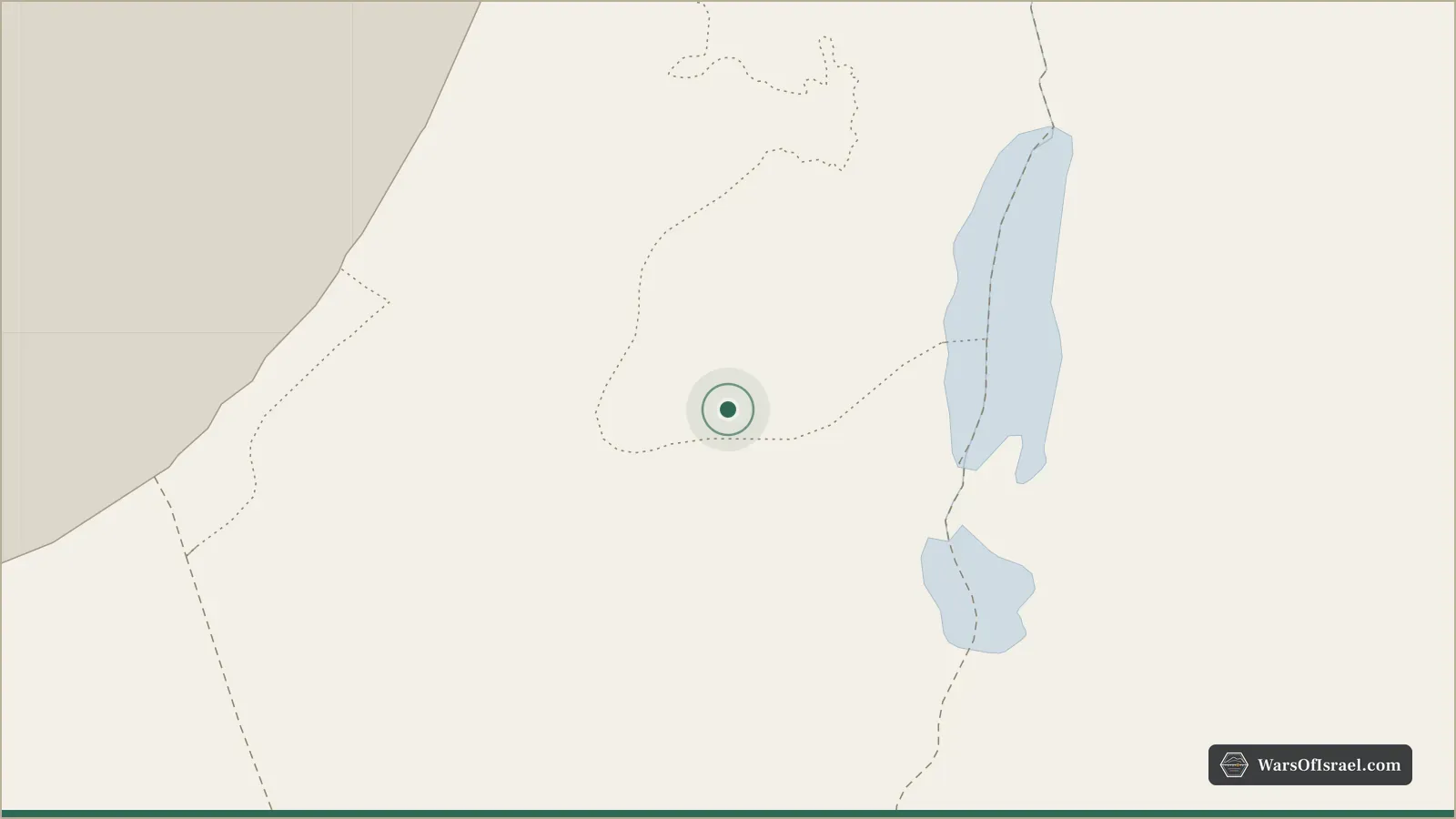
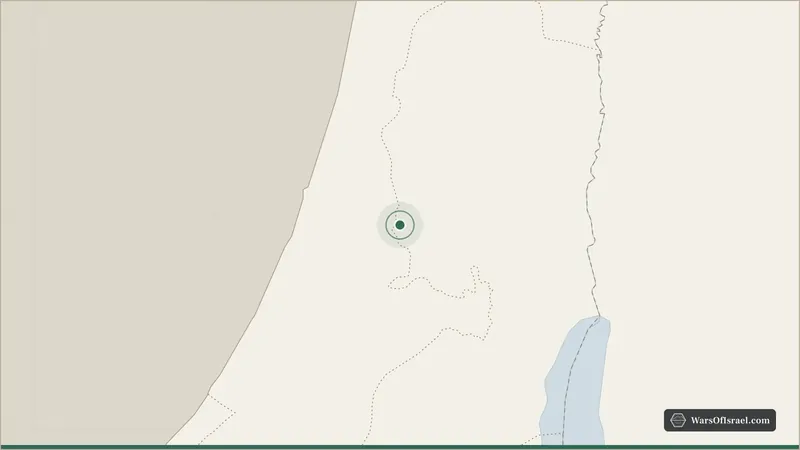
On the morning of November 13, 1966, an Israeli force of tanks, paratroopers in half-tracks and combat engineers crossed the armistice line into the Jordanian-held West Bank and attacked the village of as-Samu, south of Hebron. The raid, codenamed Operation Shredder (Mivtza Magresa), was a reprisal for a Fatah mine that had killed three Israeli soldiers two days earlier. It turned into the largest clash between Israel and the Jordanian army since 1948. Sixteen Jordanian soldiers, including a pilot, and three civilians were killed, and one Israeli officer died. Jordan's King Hussein, who had quietly tried to restrain Fatah, faced riots across the West Bank, and the raid became one of the steps on the road to the Six-Day War.
The mine and the decision
By 1966 the main source of armed attacks on Israel was Fatah, whose raids were encouraged by Syria but often launched through Jordan. On the night of November 11 to 12, 1966, an Israeli border patrol vehicle hit a mine near the armistice line with Jordan. Three soldiers were killed and six wounded. Israel held Fatah responsible and said the cell had come from Jordanian territory.
King Hussein had been in secret contact with Israeli representatives for several years, and he sent Prime Minister Levi Eshkol a letter of condolence through the American embassy. The Israeli government nonetheless decided on a large raid, aimed at Jordan rather than at Syria, Fatah's main patron, partly because an attack on Syria risked a wider war. The choice of Jordan, and the scale of the force, have since been criticized by historians.
The raid
The plan was to enter as-Samu, order the residents out and demolish houses that Israel believed had sheltered Fatah members. According to the IDF Archives, the force included Centurion tanks, about 400 paratroopers in half-tracks and engineers. While the engineers demolished buildings, a Jordanian army battalion and a column of reinforcements rushed toward the village. The column drove into the Israeli force and was badly hit. Israeli Mirage jets and Jordanian Hawker Hunters fought over the area, and a Jordanian aircraft was shot down.
The Israeli paratroop battalion commander, Yoav Shaham, was killed in the fighting, and ten Israeli soldiers were wounded. On the Jordanian side, 15 soldiers and one pilot were killed and 54 wounded, among them the column commander, and three local civilians died. Estimates of the houses destroyed differ: about 40 according to the IDF, and 125 according to the UN. The IDF Archives' account of the Samu incident (opens in a new tab) notes that it "took much larger dimensions than planned."
Consequences
On November 25, 1966, the UN Security Council unanimously censured Israel in resolution 228 for a large-scale military action in violation of the UN Charter and the armistice agreement. The United States, which had been building ties with Hussein, was displeased.
The deepest effects were in Jordan. Palestinian residents of the West Bank accused the king of failing to protect them, riots spread across the West Bank with calls for his overthrow, and Jordanian police killed four protesters. Arab radio, above all from Cairo and Damascus, attacked Hussein as weak. On November 20 he ordered general military service. Historians such as Michael Oren argue that the humiliation of Samu made it much harder for Hussein to stay out of a war, and in May 1967 he signed a defense pact with Egypt and placed his army under Egyptian command. Within Israel, the raid was later seen by many as a mistake that weakened the Arab leader most interested in quiet on the border. Its story belongs both to the history of the war over water and Fatah's raids and to the prelude of 1967.