Military operationWar of Independence
Operation Uvda and the road to Eilat (1949)
The last operation of the 1947 to 1949 war, a five-day desert march that carried Israel to the Gulf of Aqaba before the armistice lines were drawn.
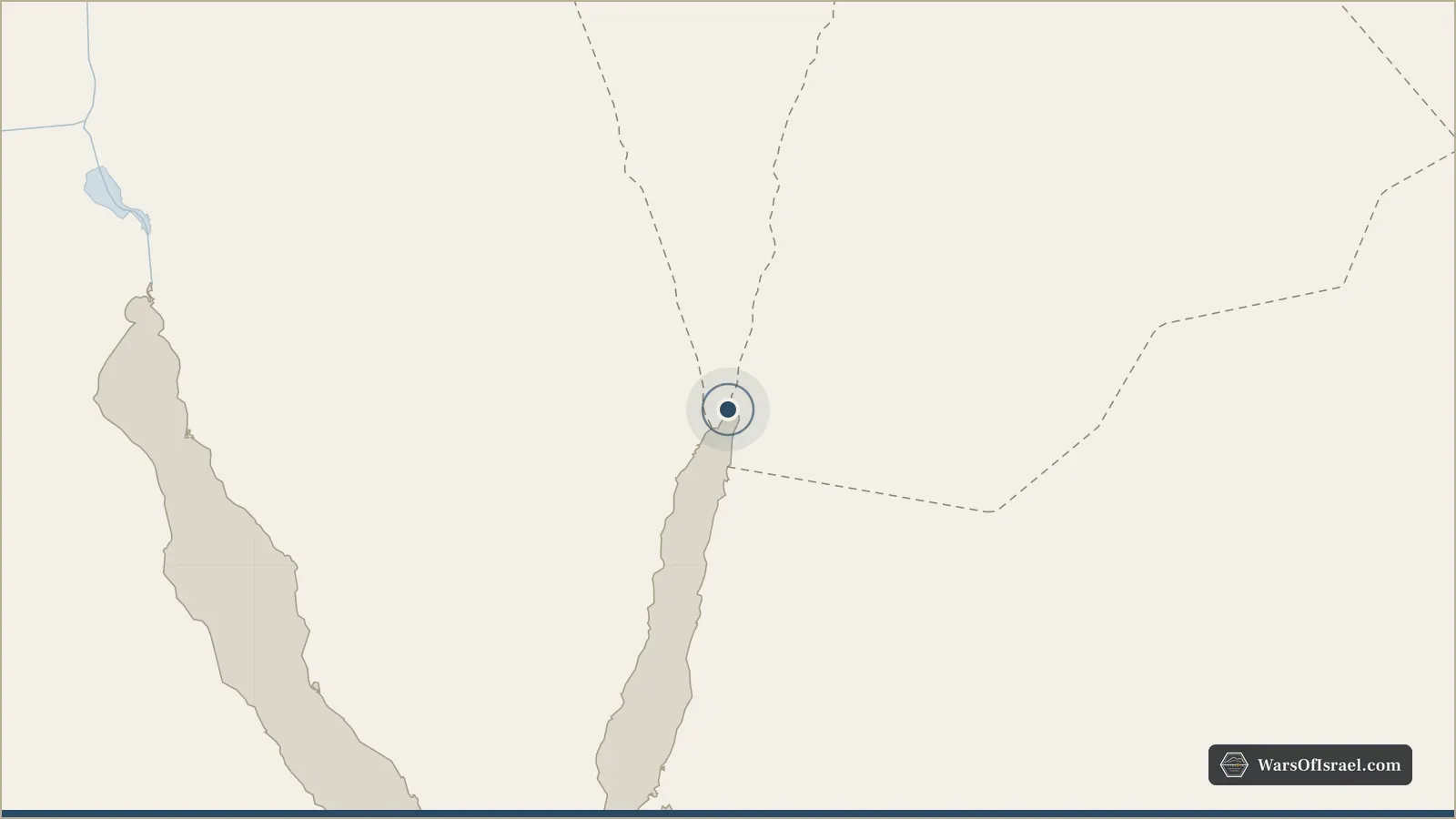
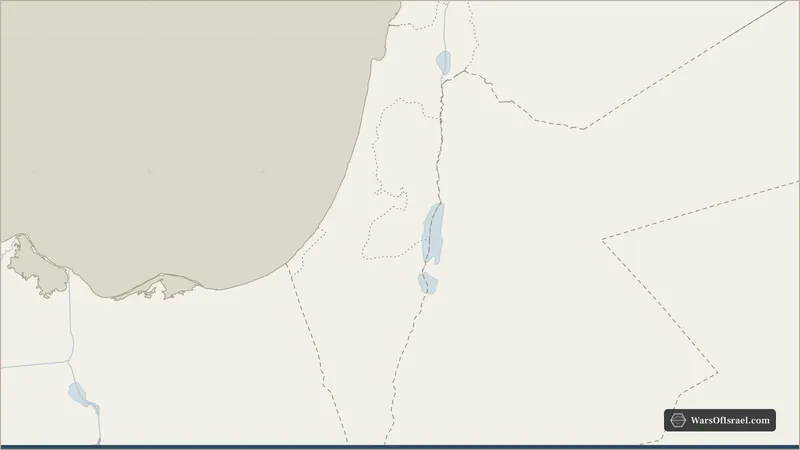
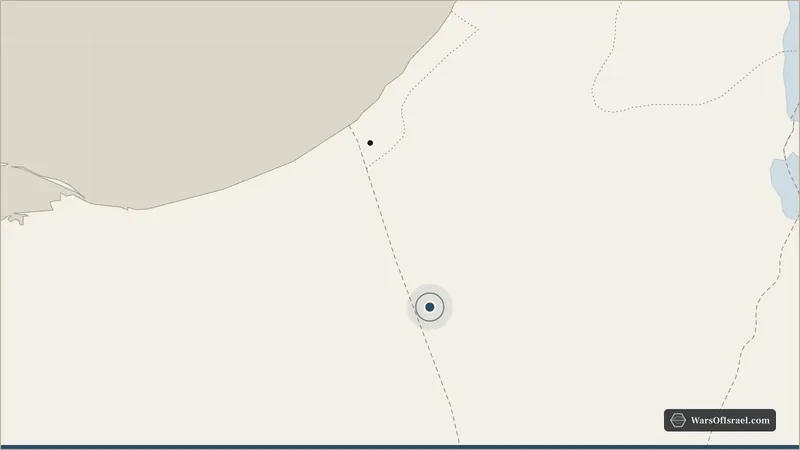
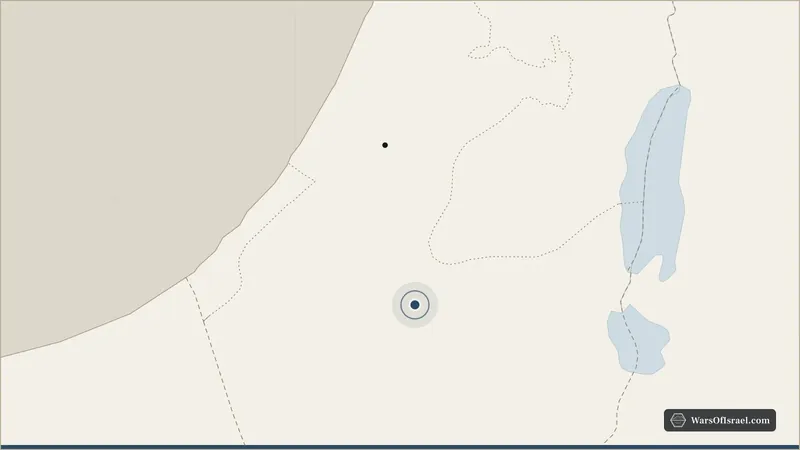
Operation Uvda was the last military operation of the 1947 to 1949 war. Between March 5 and 10, 1949, columns of the Negev and Golani brigades crossed the empty southern Negev and the Arava valley and reached the shore of the Gulf of Aqaba at Umm Rashrash, a deserted British police post. There, on the afternoon of March 10, soldiers raised a makeshift Israeli flag drawn in ink on a white sheet. Almost no shots were fired. The operation's name, Uvda, means "fact" in Hebrew, and that was its purpose: not to defeat an enemy army but to create a fact on the ground, a real Israeli presence down to the shore of the gulf, before the armistice with Jordan fixed the map.
A border on paper
The southern Negev, a triangle of desert narrowing to a few kilometers of coastline at the Gulf of Aqaba, had been allotted to the Jewish state in the UN partition plan of November 1947. For most of the war, though, it was empty of armies. Egyptian forces had held the roads further north, Jordan's Arab Legion had small posts in the area, and the British, who still had treaty forces in Jordan, had a garrison at Aqaba across the bay.
By early 1949 the situation had changed. Operation Horev had driven the Egyptian army out of the Negev, and Egypt signed its armistice with Israel on Rhodes on February 24, 1949. Talks with Jordan were under way. In them, Jordan claimed the southern Negev, and there was a real possibility that the armistice lines would be drawn according to where forces stood on the day of signing. An Israeli outlet to the Red Sea depended on getting there first.
There was also a British factor. After the clash over Sinai in January, Britain had sent reinforcements to Aqaba, on the Jordanian side of the bay, and Israeli planners had to assume that any fighting near the gulf could draw in British troops bound by treaty to defend Jordan. A slow, cautious advance risked arriving after the diplomats. A fast one risked a clash with the Legion and, behind it, with Britain.
David Ben-Gurion and the General Staff decided to move. The orders stressed that the forces were to avoid fighting with the Arab Legion if possible, and to advance only through territory assigned to Israel under the partition plan.
Forces and routes
The operation was commanded by Yigal Allon as head of the Southern Front. Three brigades took part, each on its own axis: - The Negev Brigade under Nahum Sarig moved south from Beersheba through Bir Asluj and the Ramon crater, then down the narrow wadis of the central Negev to Ras al-Naqb and the coast. - The Golani Brigade advanced through the Arava valley along the Jordanian border, by way of Mamshit and a string of desert springs, including Ein Husub, Ein Ghamr, Gharandal and Ein Ghadyan, the site of today's Yotvata. - The Alexandroni Brigade operated further north on the Dead Sea front in a related move, Operation Itzuv.
The real enemies were distance and terrain. The routes ran through territory with almost no roads. Vehicles had to be dug out of sand, tracks had to be cleared by engineers, and parts of the force were supplied by air. The Negev Brigade's route through the canyons south of the Ramon crater had been scouted only weeks earlier.
The march to the Red Sea
The operation began on March 5, 1949. On the eastern route, Golani moved down the Arava while Arab Legion detachments, under orders not to fight, pulled back from positions such as Ein Ghamr as the Israeli columns approached. On the western route, the Negev Brigade worked its way south through the mountains. At Ras al-Naqb, above the coast, the Legion had reoccupied posts that it had abandoned earlier, but there too it withdrew without a serious clash.
Further north, Alexandroni troops sailed across the Dead Sea from Sodom and landed at Ein Gedi before dawn on March 8, then secured the area around Masada. This move brought the western shore of the Dead Sea south of Ein Gedi under Israeli control.
The race between the two brigades, each eager to be first to the water, ended at Umm Rashrash. The Negev Brigade's forward unit arrived first, in the afternoon of March 10, about two hours ahead of Golani. The police station was empty.
The Ink Flag
The soldiers had no Israeli flag with them. On the orders of the brigade commander, Sarig, they improvised one: a white sheet with two blue stripes drawn in ink and a Star of David cut from a first-aid kit sewn on. Captain Avraham Adan, a company commander in the brigade's 8th Battalion and later a general in the Yom Kippur War, climbed a pole at the police station and raised it, while a soldier named Micha Perry photographed the moment. The picture, with its echo of the 1945 photograph of the flag raising on Iwo Jima, became one of the best known images of the war.
The "Ink Flag" (Degel HaDyo) is often described in Israel as the symbolic end of the War of Independence. Golani, arriving later, raised a regular flag. A sculpture by Daniel Kafri now marks the spot, which was declared a national heritage site in 1994.
Outcome and significance
The diplomatic sequel came quickly. In the final stage of the talks with Jordan, as the Iraqi army prepared to hand its sector in Samaria over to the Arab Legion, Israel used its strengthened position to press for changes in the line. A secret agreement dated March 23, 1949 allowed the ceasefire line to be redrawn both in the southern Negev and in the Wadi Ara area in the north. King Abdullah, anxious to secure the West Bank and avoid renewed fighting, accepted.
The armistice with Lebanon was signed on March 23, 1949, and the agreement with Jordan on April 3, 1949. In the Jordanian talks, the southern Negev was now held by Israeli forces, and the armistice line in the south followed the border of the Mandate, leaving Umm Rashrash and the coast west of Aqaba to Israel. The war, which had begun with fighting in the cities and on the roads in late 1947, ended on the shore of a desert gulf hundreds of kilometers to the south.
For Israel, Uvda's results were permanent. The town of Eilat grew on the site of the police post in the years that followed, and with it Israel's only port on the Red Sea, its gateway to East Africa and Asia without passing through the Suez Canal. Freedom of passage through the Straits of Tiran to Eilat became a central issue in Israeli strategy: its closure by Egypt was one of the causes of the Sinai campaign of 1956 and the Six-Day War.
Uvda was also an unusual operation in a war marked by heavy fighting and mass displacement. It involved no major battle and no populated towns, and its success depended more on logistics, timing and diplomacy than on combat. For the history of the 1947 to 1949 war, it shows how much of the final map was set not only by the decisive battles in the center and north, but also by marches into areas that no army had yet claimed on the ground.
Timeline
- November 29, 1947: The UN partition plan allots the southern Negev to the Jewish state.
- February 24, 1949: Egypt and Israel sign their armistice agreement on Rhodes.
- March 5, 1949: Operation Uvda begins with columns moving south from Beersheba and into the Arava.
- March 8, 1949: Alexandroni troops land at Ein Gedi after crossing the Dead Sea.
- March 10, 1949: The Negev Brigade reaches Umm Rashrash and raises the Ink Flag; Golani arrives about two hours later.
- March 23, 1949: Israel and Lebanon sign their armistice agreement.
- April 3, 1949: Israel and Jordan sign their armistice agreement, leaving the southern Negev in Israeli hands.
- January 19, 1994: The site of the Ink Flag is declared a national heritage site.