Riots and disturbancesBritish Mandate
The 1921 Jaffa riots
How a quarrel between two Jewish socialist marches set off a week of killing in Jaffa and the colonies, and how Britain answered it.
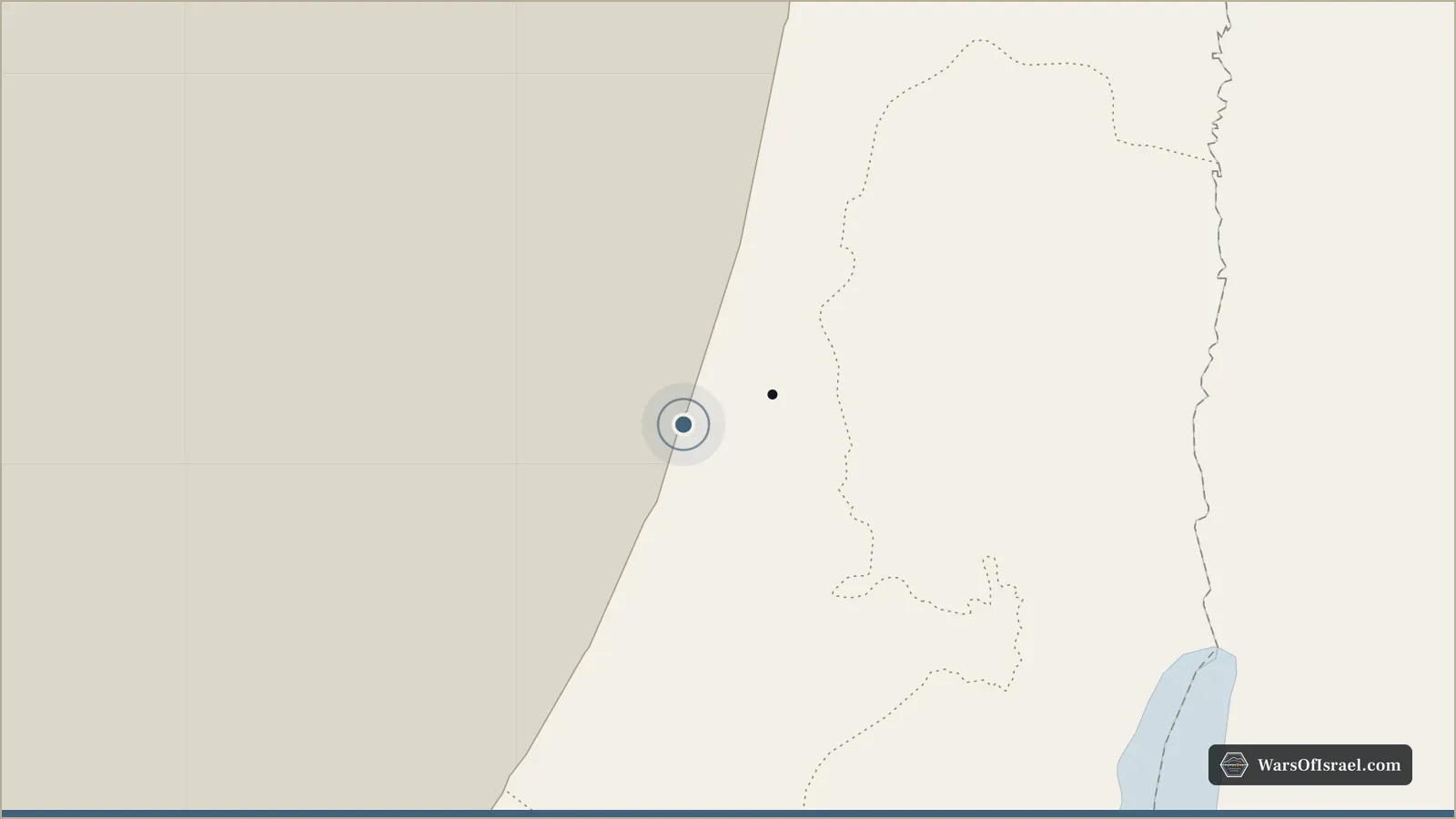
The Jaffa riots of May 1921 were the deadliest outbreak of violence between Arabs and Jews in the first years of British rule in Palestine. They began on May 1, 1921 with a brawl between two rival Jewish socialist marches in Jaffa and, within hours, turned into Arab attacks on Jews across the town. Over the following week the violence spread to Jewish colonies in the coastal plain, including Petah Tikva and Hadera. According to the official British commission of inquiry, 47 Jews and 48 Arabs were killed and 219 wounded people were admitted to hospitals. The riots led Britain to suspend Jewish immigration for a time and to redefine, in more cautious terms, what its promise of a Jewish national home would mean.
Jaffa in 1921
Jaffa was the main port of Palestine and its most cosmopolitan town. Its population was mostly Arab, Muslim and Christian, but several thousand Jews lived there, many in mixed neighborhoods and in the quarters along the road north to Tel Aviv. Tel Aviv itself, founded in 1909 as a Jewish garden suburb on Jaffa's sand dunes, was still administratively part of Jaffa.
The town was also the gateway for immigrants. After the war Jewish immigration resumed, and the newcomers of the Third Aliyah, many of them young socialists from Russia and Poland, passed through Jaffa on their way to the colonies and the labor camps. The Zionist Commission ran an immigrants' hostel, the Beit HaOlim or Immigration House, in the town; in the first days of May 1921 it housed about a hundred recent arrivals.
A year after the riots in Jerusalem, British rule had changed form. A civil administration under High Commissioner Herbert Samuel had replaced the military government in July 1920, and the San Remo conference had confirmed Britain as the mandatory power. Arab political bodies had expressed their opposition to the Balfour Declaration through congresses, petitions and delegations, with little result. Fear of large-scale Jewish immigration was widespread, and economic hardship after the war sharpened it.
The forces and parties
The violence involved several groups that need to be distinguished:
- The Jewish Communist Party (known by its Yiddish initials as MPS), a small, illegal group that opposed Zionism and called for a "Soviet Palestine."
- Ahdut HaAvoda, the main Zionist labor party, which held an authorized May Day parade in Tel Aviv.
- Arab residents of Jaffa and, later, men from villages in the coastal plain and the Sharon who joined the attacks on Jews and Jewish colonies.
- The Palestine Police, most of whose rank and file in Jaffa were Arab, and its British officers.
- British and Indian troops and armored cars, and the Royal Navy, brought in to restore order.
- The newly formed Haganah, former Jewish Legion soldiers and armed colonists, who defended Jewish neighborhoods and colonies.
Week of violence
May 1: Jaffa
On April 30 the Jewish communists distributed leaflets calling for a "Soviet Palestine." On the morning of May 1 their unauthorized march, some fifty people, moved from Jaffa toward Tel Aviv and met the authorized Ahdut HaAvoda parade near the border between the two towns. A fistfight broke out. The police intervened to disperse the communists, and the clash spilled into the Manshiyya neighborhood.
Arab residents, who had seen Jews fighting and police charging, began attacking Jews in the streets. The Haycraft Commission later found that rumors had spread that Jews were attacking Arabs, and that these rumors helped turn a street brawl into a general assault. Shops were looted and Jewish houses broken into in several neighborhoods. The sequence suggests how thin the line between a political quarrel and communal violence had become: a dispute among Jews over socialism and Zionism was read on the street as a Jewish attack, and within an hour the target was no longer the communists but any Jew within reach.
At about 1:30 in the afternoon a crowd attacked the Immigration House. According to the commission's report, 13 Jews were killed or mortally wounded and 24 wounded there. Witnesses told the commission that Arab policemen had taken part in the attack, and the commission confirmed that some members of the police had participated in the violence or led it.
May 2 to 4: Jaffa and Abu Kabir
The killing continued the next day. On May 2 a group of attackers reached a dairy farm at Abu Kabir, on the eastern edge of Jaffa, where the Hebrew writer Yosef Haim Brenner was living as a tenant. Brenner, the farmer Yehuda Yitzker, his teenage son, his son-in-law and two other residents were killed. Brenner was one of the most important Hebrew writers of his generation, and his death made the riots a defining event in Hebrew literature and memory. Three Arab men were later tried for the murders and acquitted for lack of sufficient evidence.
Jews in Jaffa fled in large numbers to Tel Aviv, where thousands were housed in tents and public buildings. Jewish defenders in Tel Aviv, including former soldiers of the Jewish Legion, guarded the boundary of the town. There were also Jewish acts of revenge, and the commission recorded Arab deaths in Jaffa during these days, though it could not establish how many were caused by Jews.
Not every official stood aside. The commission's papers and later accounts credit a British officer, Major Lionel Mansell Jeune, with saving about a hundred Jewish immigrants during the attack in Jaffa.
High Commissioner Samuel declared a state of emergency, imposed press censorship and asked for reinforcements from Egypt. Destroyers were sent to Jaffa and Haifa. Within days the troops had regained control of the town.
May 5 to 7: the colonies
As news and rumor spread, armed men from the villages attacked several Jewish colonies. The residents of Kfar Saba, a small and isolated settlement, abandoned it on May 3 after an alarm; when British officers visited on May 6 they found houses burned. On Thursday, May 5, Petah Tikva, the oldest of the colonies in the area, was attacked by a large force of villagers. The colonists held out until British forces arrived and drove the attackers off; four of its Jewish residents were killed.
On May 6 a raid was made on Hadera. In an interim report the commission found that the attack "was in all its elements an improvised affair" and a sequel to the Jaffa riots; three Arabs were killed and several police were wounded. Rehovot was also threatened. Most of the Arab casualties in the attacks on the colonies were caused by British forces rather than by the colonists. By May 7 the violence had subsided.
The human cost
The official figures, as set out in the report of the Haycraft Commission, are these:
| Group | Killed | Wounded |
|---|---|---|
| Jews | 47 | 146 |
| Arabs | 48 | 73 |
Source: Palestine. Disturbances in May, 1921, Reports of the Commission of Inquiry (Cmd. 1540), 1921.
Most of the Jewish dead were killed in Jaffa on May 1 and 2. Most of the Arab dead were killed by the police and by British forces suppressing the attacks, particularly around the colonies. The commission noted that it could not determine how many Arabs were killed by Jews.
The 219 wounded were hospital admissions: 146 Jews and 73 Arabs. The commission explained that some less seriously injured people were treated outside hospitals, so this is not a count of every injury.
The Haycraft Commission
Samuel appointed a commission of inquiry headed by Sir Thomas Haycraft, the Chief Justice of Palestine. Its report, presented to Parliament in October 1921, can be read today in the full text of the Haycraft Commission report (opens in a new tab). Its main findings were these:
- The violence began with the May Day clash between Jewish factions, but the Arabs were responsible for the attacks that followed, and the commission did not find that the outbreak had been planned in advance.
- The underlying cause was a feeling of discontent and hostility among Arabs toward Jews, rooted in political and economic grievances connected with Jewish immigration and with what Arabs perceived as Zionist policy.
- Zionist representatives had not done enough to allay Arab apprehensions, and the conduct of some Jewish immigrants, including the Bolshevik agitation of the communists, had fed Arab fears.
- Members of the police, most of them half-trained, had in some cases taken part in the riots, while the military and civil authorities had on the whole acted adequately once the scale of the violence was clear.
Zionist leaders rejected the commission's emphasis on Jewish behavior as a cause, arguing that it treated the victims' presence as provocation. Arab leaders welcomed its recognition of their grievances. Historians since have read the report as an early statement of a dilemma that ran through the Mandate: Britain was committed to a national home for the Jews but was told by its own inquiries that the policy itself was the source of the unrest.
Consequences
The riots had immediate and lasting effects:
- Samuel temporarily suspended Jewish immigration. Ships already approaching carrying about 300 Jewish immigrants were not allowed to land and were sent back to Istanbul. In a speech in June 1921 Samuel said that immigration would be permitted in numbers the economy could absorb.
- In the same period Samuel appointed Haj Amin al-Husseini, who had been convicted in absentia for his part in the Jerusalem riots of 1920 and later pardoned, as Mufti of Jerusalem.
- The British disbanded what remained of the Jewish battalions of the Jewish Legion, ending the idea of a Jewish unit in the Mandate garrison. Some of its veterans became instructors in the Haganah.
- The riots accelerated the separation of Tel Aviv from Jaffa. Thousands of Jewish refugees from Jaffa settled in the new town, and in 1921 it was given the status of a separate township.
- Three Jews, one of them a policeman, were convicted of killing Arabs during the riots. The verdicts provoked protests abroad, and the Supreme Court later acquitted them on grounds of self-defense.
- Arab leaders petitioned the League of Nations for independence and representative government, and in the summer of 1921 an Arab delegation headed by Musa Kazim al-Husseini traveled to London to press its case against the Balfour Declaration.
- Violence returned to Jerusalem on November 2, 1921, the anniversary of the Balfour Declaration, when five Jews and three Arabs were killed in and around the Jewish Quarter.
- Several Arab villages were fined collectively for their part in the attacks, among them Tulkarm, Qalqilya and Kafr Saba.
The longer-term consequence was a new British statement of policy. The White Paper issued by Colonial Secretary Winston Churchill in June 1922 reaffirmed the Balfour Declaration, but defined the national home as a center for the Jewish people in Palestine rather than the conversion of Palestine into a Jewish state, and tied immigration to the country's "economic capacity" to absorb newcomers.
Legacy and memory
For the Yishuv, the Jaffa riots confirmed the lesson already drawn in Jerusalem: Jewish life could not depend on British protection. The young Haganah grew in size and organization in the years that followed. It also drew a second lesson that would shape the rest of the Mandate period: that the economic and political separation of Jews and Arabs, symbolized by the growth of Tel Aviv as a Jewish city apart from Jaffa, would continue.
In Hebrew memory the riots are known as מאורעות תרפ"א, after the Hebrew year 5681, and they are associated above all with the death of Brenner, who is buried in the Trumpeldor cemetery in Tel Aviv. The story of the defense of Petah Tikva and Hadera joined that of Tel Hai as part of the narrative of the colonies that held their ground. In Arab memory the events were part of a broader resistance to the Mandate's Zionist policy, a theme that returned with greater force in the riots of 1929 and in the Arab Revolt of 1936 to 1939.
Timeline
- April 30, 1921: The Jewish Communist Party distributes leaflets calling for a "Soviet Palestine."
- May 1, 1921: A clash between communist and Ahdut HaAvoda marchers in Jaffa sets off Arab attacks on Jews; 13 Jews are killed at the Immigration House.
- May 2, 1921: Yosef Haim Brenner and five others are killed at Abu Kabir.
- May 3, 1921: The residents of Kfar Saba abandon the colony.
- May 5, 1921: Arab villagers attack Petah Tikva; four Jewish residents are killed.
- May 6, 1921: A raid is made on Hadera.
- May 7, 1921: The violence subsides.
- October 1921: The Haycraft Commission report is presented to Parliament.
- June 1922: The Churchill White Paper redefines British policy on the Jewish national home.