UprisingSecond intifada to the Gaza operations
The second intifada (2000 to 2005)
The article explains how the collapse of the Oslo process turned into five years of bombings, raids and sieges, and how the uprising reshaped Israel and the Palestinian territories.
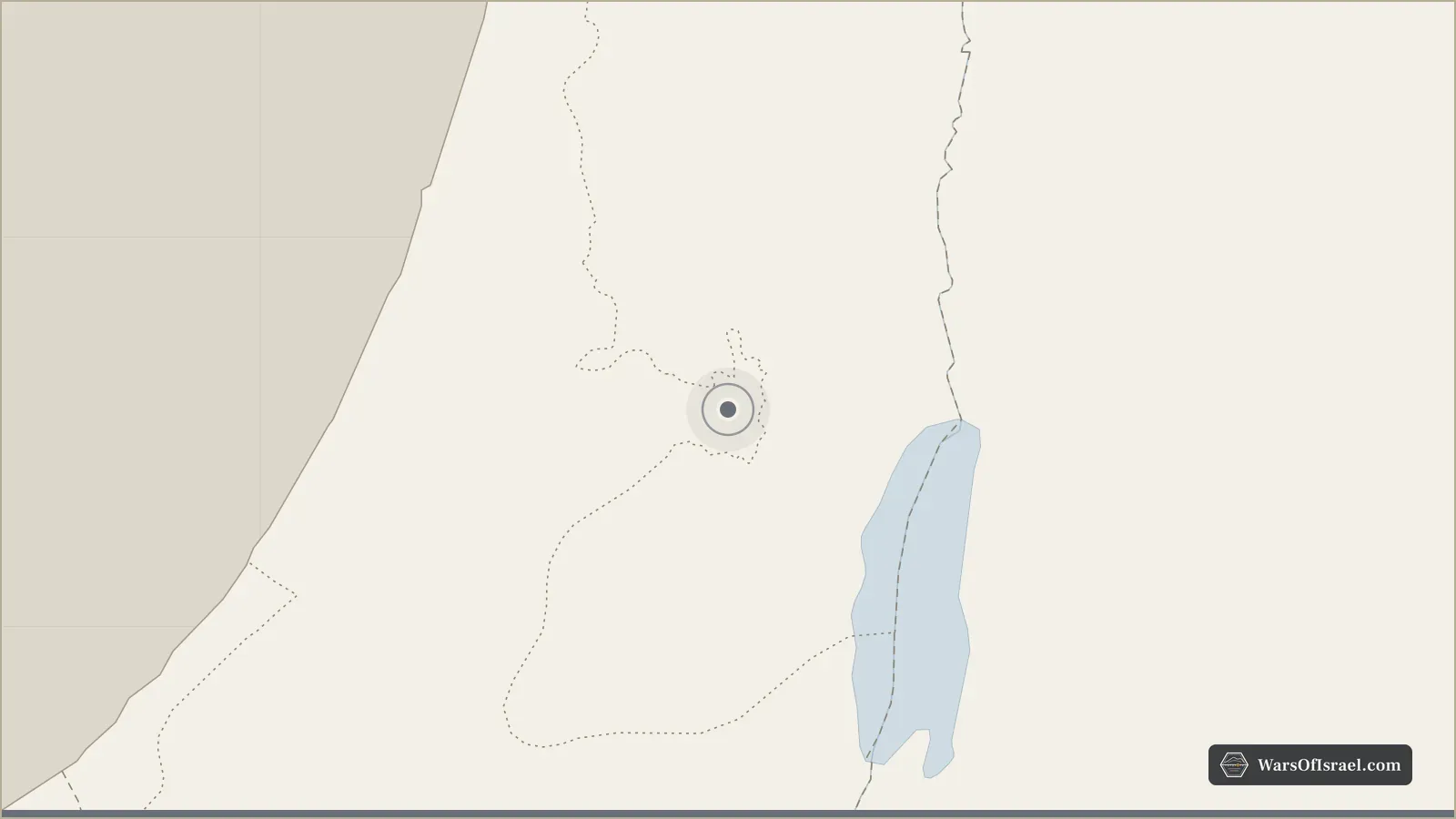
The second intifada was an armed Palestinian uprising against Israel that began at the end of September 2000, two months after the Camp David summit failed, and faded out in early 2005. Palestinians often call it the al-Aqsa intifada. It was far deadlier than the first intifada: where the uprising of 1987 was fought mostly with stones and strikes, this one was fought with rifles, roadside bombs and, above all, suicide bombers sent into Israeli cities. Israel answered with targeted killings, closures and, from 2002, the reoccupation of West Bank cities that it had handed to the Palestinian Authority under the Oslo Accords. By the count of the Israeli human rights organization B'Tselem, 3,386 Palestinians and 992 Israelis were killed between September 29, 2000 and the end of 2005. The numbers are only part of the story. The uprising buried the Oslo framework, brought Ariel Sharon to power, produced the West Bank barrier and set the stage for Israel's withdrawal from Gaza.
A peace process that ran out of road
The Oslo Accords of 1993 and 1995 created the Palestinian Authority and transferred the main Palestinian cities of the West Bank and Gaza to its control, while leaving the hardest questions for a final agreement: borders, settlements, Jerusalem, refugees and security. Those talks were meant to conclude by 1999. They had not. Through the late 1990s, both societies watched the interim period sour. Israelis saw Hamas and Palestinian Islamic Jihad bombings in Jerusalem, Tel Aviv and elsewhere, and doubted that Yasser Arafat would or could stop them. Palestinians saw settlements growing, checkpoints multiplying and a state that kept failing to arrive.
Prime Minister Ehud Barak tried to break the deadlock in one stroke. At Camp David, from July 11 to 25, 2000, he, Arafat and President Bill Clinton negotiated for two weeks over a final settlement. The summit ended without agreement, and each side left convinced that the other had wasted a historic opportunity. Israeli officials, and Clinton himself, blamed Arafat for rejecting proposals without offering his own. Palestinian negotiators said the offer fell short of a viable state, especially in Jerusalem. The question of whether Arafat planned the violence that followed, or merely allowed it to grow, has divided historians and intelligence officials ever since.
How the uprising began
On September 28, 2000, Ariel Sharon, then leader of the opposition Likud party, visited the Temple Mount (al-Haram al-Sharif) in Jerusalem accompanied by a large police escort. The next day, after Friday prayers, Palestinian protesters clashed with Israeli police at the site and several Palestinians were killed. Within days the confrontation spread across the West Bank and Gaza. The IDF and Defense Establishment Archives date the start of the intifada to September 29, 2000.
Three episodes from those first weeks fixed the uprising in public memory:
- On September 30, 2000, twelve-year-old Muhammad al-Durrah was killed in an exchange of fire at the Netzarim junction in Gaza. Footage broadcast by France 2 made him a symbol across the Arab world; who fired the fatal shots has remained in dispute.
- In early October, protests spread to Arab towns inside Israel. Israeli police killed twelve Arab citizens of Israel and one Palestinian from Gaza. The state commission of inquiry headed by Justice Theodor Or later criticized the police and political leadership severely.
- On October 12, 2000, two Israeli reservists who had entered Ramallah by mistake were killed by a crowd inside a Palestinian police station, an image that hardened Israeli opinion just as al-Durrah's death had hardened Palestinian opinion.
The international fact-finding committee led by former US Senator George Mitchell, which reported in 2001, called Sharon's visit poorly timed but found no basis to conclude that it was planned by either side as the trigger for a deliberate campaign of violence. It recommended a ceasefire, a settlement freeze and a Palestinian crackdown on attacks. None of the three happened.
The parties and their methods
The uprising was not run by a single command. On the Palestinian side, the main armed groups were:
- Hamas, through its military wing, the Izz ad-Din al-Qassam Brigades, which carried out many of the deadliest suicide bombings;
- Palestinian Islamic Jihad, smaller but active in Jenin and Gaza;
- the al-Aqsa Martyrs' Brigades and the Tanzim, armed networks linked to Arafat's own Fatah movement, which adopted suicide bombing from early 2002;
- the Popular Front for the Liberation of Palestine, which assassinated Israel's tourism minister, Rehavam Ze'evi, in Jerusalem on October 17, 2001;
- members of the Palestinian Authority's own security services, some of whom took part in shooting attacks.
Israel fought with the IDF, the Israel Security Agency (Shin Bet) and the Israel Police. Its methods changed as the war did: closures and curfews on Palestinian towns, raids to arrest suspects, helicopter and air strikes against commanders and bomb makers, which Israel called targeted prevention and critics called extrajudicial killing, and later the large-scale reentry into Palestinian cities.
The asymmetry was stark. The Palestinian groups could not threaten Israel's army, but they could reach its buses, cafes, hotels and nightclubs. Israel could reach almost any Palestinian town, but every raid, demolition and closure fed the recruitment it was meant to stop.
The course of the uprising
From clashes to bombings (2000 to 2001)
In its first months, the intifada was dominated by mass clashes at checkpoints and settlement junctions, and by shooting on West Bank roads. Barak's government fell, and on February 6, 2001, Ariel Sharon defeated him by a wide margin in a direct election for prime minister. The suicide bombings then grew in frequency and lethality. On June 1, 2001, a bomber killed 21 people, most of them teenagers, outside the Dolphinarium discotheque in Tel Aviv. On August 9, 2001, a bombing at the Sbarro pizzeria in Jerusalem killed 15. Each attack was followed by Israeli strikes and closures, and every ceasefire, including one brokered by CIA director George Tenet in June 2001, broke down within weeks.
On January 3, 2002, Israeli naval commandos seized the Karine A, a freighter in the Red Sea carrying about 50 tons of weapons. Israel said the shipment had been organized by officials of the Palestinian Authority with Iranian help. For the Bush administration, the affair badly damaged Arafat's credibility as a partner.
March 2002 and Defensive Shield
March 2002 was the bloodiest month of the uprising for Israelis. According to the UN Secretary-General's report on the period, bombings between early March and May 7, 2002 killed more than 100 people in Israel. On the evening of March 27, the first night of Passover, a Hamas bomber walked into the dining hall of the Park Hotel in Netanya during the seder and killed 30 people.
Two days later Israel launched Operation Defensive Shield, its largest military operation in the West Bank since 1967. The IDF entered Ramallah on March 29, besieged Arafat in his Mukataa compound, then moved into Tulkarm, Qalqilya, Bethlehem, Nablus and Jenin. The fiercest fighting was in the Jenin refugee camp, where 23 Israeli soldiers and at least 52 Palestinians were killed, according to the United Nations. Palestinian officials' early claims of a massacre of hundreds were not borne out by the UN, Human Rights Watch or other investigators, although Human Rights Watch found evidence of serious violations by the IDF.
Reoccupation, the barrier and attrition (2002 to 2004)
Defensive Shield did not end the uprising, but it changed its geography. From the summer of 2002, the IDF kept forces in or around the Palestinian cities and raided them nightly, which it said dismantled the bomb-making networks at their source. On June 23, 2002, the Israeli government approved the first phase of a separation barrier in the West Bank, which its decision described as a security measure and not a border. The barrier, a fence in most places and a concrete wall in some, became one of the most contested legacies of the war: Israeli officials credit it with a sharp fall in suicide bombings, while Palestinians and the International Court of Justice, in a 2004 advisory opinion, objected to its route inside the West Bank.
Politically, the war isolated Arafat. On June 24, 2002, President George W. Bush called for a new Palestinian leadership. In 2003, Mahmoud Abbas became the first Palestinian prime minister and the international Quartet launched the Road Map, a phased plan toward a Palestinian state. A temporary truce declared by the armed factions in the summer of 2003 collapsed within weeks. Attacks continued, among them the bombing of the Maxim restaurant in Haifa in October 2003, but at a declining rate. Israel escalated its targeted killings, including Hamas founder Sheikh Ahmed Yassin on March 22, 2004, and his successor, Abdel Aziz al-Rantisi, on April 17, 2004.
The fade-out (2004 to 2005)
There was no surrender and no signed peace. The intifada ended through exhaustion, politics and the death of its central figure. Arafat died in Paris on November 11, 2004. Abbas, who had publicly criticized the militarization of the uprising, was elected president of the Palestinian Authority on January 9, 2005. On February 8, 2005, at a summit in Sharm el-Sheikh, Sharon and Abbas declared a mutual cessation of violence. Hamas and Palestinian Islamic Jihad said they were not bound by it, and attacks did not stop altogether, but the scale of the war fell sharply. Historians date the end differently, to Arafat's death, to the Sharm el-Sheikh summit or to the Gaza disengagement of 2005; 2005 is the most common choice.
The human toll
Casualty figures for the second intifada vary with the source, the dates covered and the definition of who counts as a combatant. They are best read side by side:
- The IDF and Defense Establishment Archives state that by the end of 2003, about 900 Israelis had been killed and more than 7,000 injured.
- B'Tselem counted 992 Israelis killed by Palestinians between September 29, 2000 and the end of 2005, of whom 683 were civilians and 309 members of the security forces.
- For the same period, B'Tselem counted 3,386 Palestinians killed, of whom it classified 1,815 as not participating in hostilities when they were killed, 1,008 as participating and 563 as unknown.
Israeli research institutes have argued that a larger share of the Palestinian dead were combatants than B'Tselem's classification suggests, and Palestinian organizations have published higher totals. What no source disputes is that Israeli civilians made up most of the Israeli dead, the result of a campaign aimed at buses, restaurants and public spaces, and that Palestinian civilians, including children, made up a large part of the Palestinian dead. Behind every figure are thousands of wounded, bereaved families and, on the Palestinian side, homes demolished and an economy that contracted severely under closure.
Consequences
The uprising reshaped both societies. For many Israelis, especially on the center-left, it was the moment they stopped believing that a negotiated settlement was close; the Labor party's long decline dates in part from these years. The idea that security came first, and that Israel might have to act unilaterally, gained ground. Sharon's disengagement plan, under which Israel removed all its settlements and soldiers from the Gaza Strip in August and September 2005, grew directly out of that logic, and its consequences are traced in the article on Gaza and Israel since 2005.
For Palestinians, the intifada destroyed much of the Palestinian Authority's infrastructure, deepened the fragmentation of the West Bank and strengthened Hamas at Fatah's expense, a shift confirmed when Hamas won the Palestinian legislative elections in January 2006. The checkpoints, permits and barrier that defined Palestinian life afterward were largely built during these years.
Militarily, the war became the IDF's school for counterterrorism. Integrated intelligence, arrests at night, precise air strikes and the barrier were developed or expanded under the pressure of the bombings, and they shaped Israeli security doctrine for the following two decades.
Memory and interpretation
Israelis and Palestinians remember these years in almost opposite terms. In Israel the period is remembered through the sites of the attacks, the memorials at bus stops and restaurants, and the fear that kept people away from crowded places. Journalists Amos Harel and Avi Isacharoff, in their history of the war, called it the seventh war, placing it alongside Israel's conventional wars, and argued that Israel had won militarily without achieving its political goals. Palestinians remember a popular uprising against occupation that turned into a war against a far stronger army, with the reoccupation of their cities, the siege of Arafat and the destruction in Jenin and Nablus at its heart. Many Palestinian writers have also criticized the turn to suicide bombing as a strategic and moral disaster for their own cause.
What both narratives share is the sense that September 2000 closed a door. The generation that came of age during the second intifada grew up after the hopes of Oslo, and the patterns of separation, suspicion and periodic violence that followed can be traced back to these five years.
Timeline
- July 11, 2000: The Camp David summit opens; it ends on July 25 without agreement.
- September 28, 2000: Ariel Sharon visits the Temple Mount in Jerusalem.
- September 29, 2000: Clashes at the Temple Mount after Friday prayers mark the start of the uprising.
- February 6, 2001: Sharon is elected prime minister.
- June 1, 2001: The Dolphinarium bombing in Tel Aviv kills 21 people.
- January 3, 2002: The Israeli navy seizes the weapons ship Karine A in the Red Sea.
- March 27, 2002: The Passover bombing at the Park Hotel in Netanya kills 30 people.
- March 29, 2002: Operation Defensive Shield begins with the entry into Ramallah.
- June 23, 2002: The Israeli government approves the first phase of the West Bank barrier.
- November 11, 2004: Yasser Arafat dies in Paris.
- February 8, 2005: Sharon and Abbas declare a mutual cessation of violence at Sharm el-Sheikh.