Guides
The periods of Israel's military history, from 1900 to today
How more than a century of conflict divides into eight periods, and why each break falls where it does.
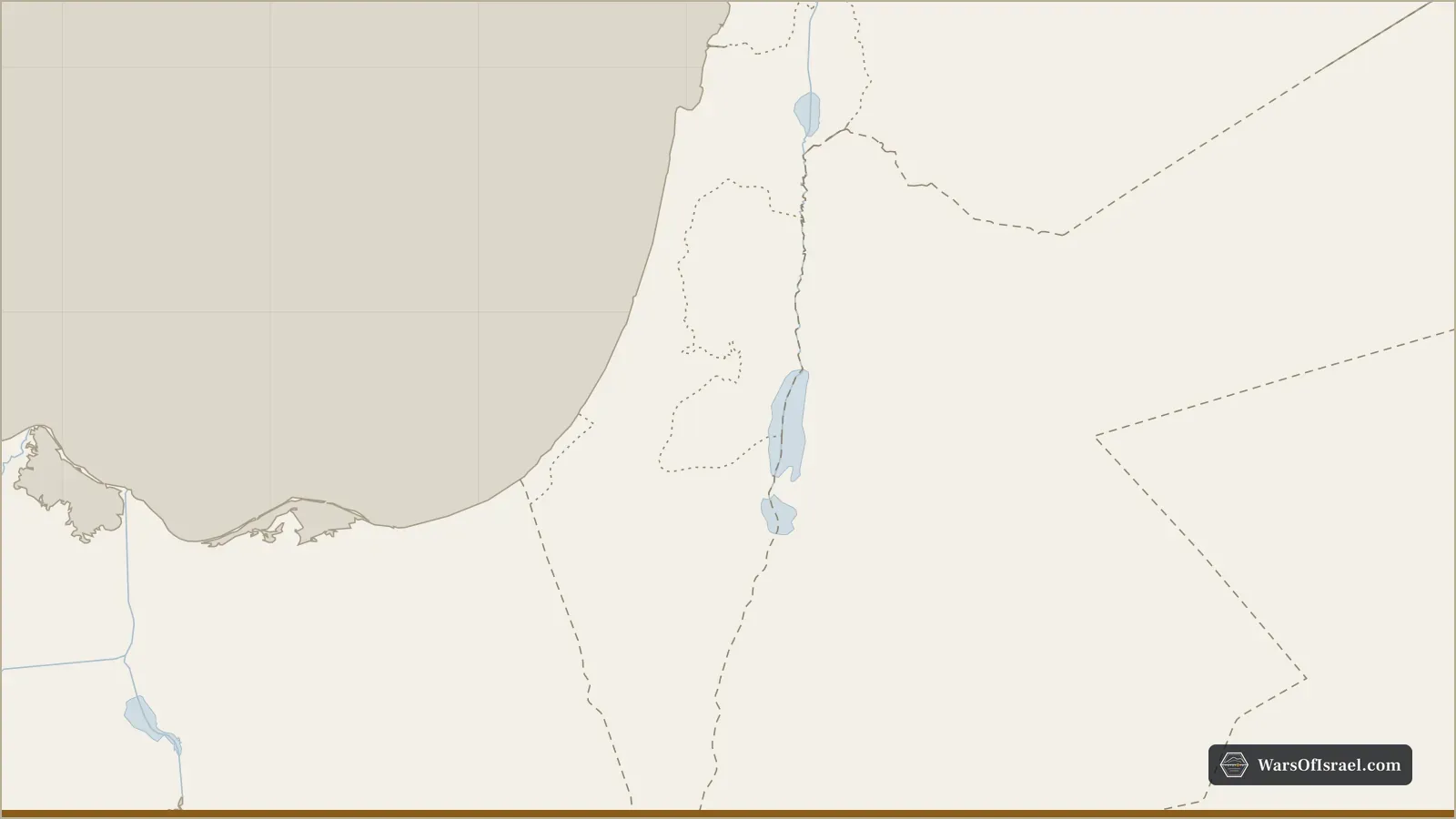
Israel's military history since about 1900 falls into eight periods, each opened by a change that altered who was fighting, over what and with which tools: the end of Ottoman rule, the British Mandate, the war of 1947 to 1949, the first two decades of statehood, the six years between the Six-Day War and the Yom Kippur War, the long era of Lebanon and the intifadas, the years from the second intifada to the Gaza operations, and the wars that began on October 7, 2023. The divisions are a tool, not a law of history. Their value lies in what they let a reader compare: a watchman on a horse in the Lower Galilee in 1909 and a missile-defense battery in 2024 belong to the same story, but not to the same chapter.
Before the state: Ottoman rule and the British Mandate (1900 to 1947)
The first period, the late Ottoman years from 1900 to 1917, is a story of small numbers. Jewish agricultural settlements were scattered across the coastal plain and the Galilee, and their security depended on local arrangements, hired guards and, from 1909, the volunteer watchmen of Hashomer and the defense of the settlements. There was no army and no state, only a claim to self-reliance that later generations would mythologize. The First World War ended this world. The British advance from Egypt, told in the record on the Sinai and Palestine campaign, brought Jerusalem under British control in December 1917 and opened the second period.
The British Mandate period, from 1917 to 1947, changed the nature of the conflict. The rival national movements, Zionist and Palestinian Arab, now faced each other under a single foreign ruler, and violence came in waves: the riots of 1920 and 1921, the much larger riots of 1929, and the Arab Revolt of 1936 to 1939, which was directed first against the British and Jewish communities and later also turned inward against Arab opponents. The Jewish community, the Yishuv, built the Haganah as an underground militia, and smaller groups, the Irgun and Lehi, broke away. After the Second World War those groups fought the British in the Jewish insurgency of 1944 to 1947, and Britain handed the question to the United Nations.
The war of 1947 to 1949 and the early state (1947 to 1967)
The third period is the shortest and the most consequential. The 1947 to 1949 war, known in Israel as the War of Independence and among Palestinians as the Nakba, began as a civil war between Jewish and Arab communities after the UN partition vote of November 29, 1947, and became an interstate war when Arab armies entered on May 15, 1948, the day after Israel declared independence. By the time the last armistice agreement was signed in July 1949, Israel existed within lines wider than the partition plan had drawn, the Palestinian Arab society of the country had been shattered, and several hundred thousand Palestinians had become refugees. Historians, Benny Morris among them, have argued for decades about the causes of that flight; the fact of it is not in dispute. The full account is in the article on Israel's War of Independence.
The fourth period, early statehood from 1949 to 1967, is often remembered as a quiet interval between two wars, which it was not. The armistice lines were porous. Infiltration across them, much of it at first by refugees trying to return or recover property and later increasingly by armed groups, met an Israeli policy of cross-border reprisal raids. These escalated into the Sinai campaign of October 1956, in which Israel fought alongside Britain and France against Egypt. The army that fought that campaign was still being invented. Its doctrine of short wars carried into enemy territory, its reliance on reservists who could be mobilized within hours, and the commando tradition of the reprisal years all took shape in this decade. So did a pattern that would return again and again: a military victory followed by political pressure, in this case American and Soviet, that forced Israel to give up its gains. Israel withdrew from Sinai and Gaza by March 1957, in exchange for a UN force on the Egyptian side of the border and assurances on shipping through the Straits of Tiran. The decade that followed brought a dispute over the Jordan River's waters, Palestinian raids launched from Syria and Jordan, and the tensions of May 1967.
From the Six-Day War to the Yom Kippur War (1967 to 1973)
The fifth period is defined by two wars and the strange interval between them. In June 1967 Israel defeated Egypt, Jordan and Syria in six days and took the Sinai Peninsula, the Gaza Strip, the West Bank, East Jerusalem and the Golan Heights. The Six-Day War created the map that framed every later negotiation, and with it the question of what to do with territories holding a large Palestinian population.
Victory did not bring calm. Egypt opened the War of Attrition along the Suez Canal, while Palestinian organizations, now with a mass following, attacked from Jordan and later from Lebanon and abroad. The confidence that grew from 1967 shaped the assessment that Egypt and Syria would not go to war, an assessment that failed on October 6, 1973. The Yom Kippur War ended with Israeli forces west of the Suez Canal and close to Damascus, but its opening days shook Israeli society, led to the Agranat Commission of Inquiry and, within a few years, to the political upheaval of 1977 and peace with Egypt.
Lebanon, the intifadas and Gaza (1974 to 2023)
The sixth period, 1974 to 1999, moves the center of gravity north and inward. With Egypt leaving the circle of war, Israel's main battles shifted to Lebanon, where Palestinian organizations had established bases. The Litani operation of 1978 and the war of 1982 were followed by eighteen years in a security zone in southern Lebanon, during which Hezbollah, founded in the early 1980s, became Israel's principal enemy there. In December 1987 a different kind of conflict began in the West Bank and Gaza: the first intifada, a popular uprising that mixed strikes, demonstrations and stone-throwing with armed attacks, and that helped lead to the Oslo agreements of 1993. The same years brought a reminder that the circle of war had not closed: in January and February 1991 Iraq fired Scud missiles at Israeli cities during the Gulf War, and Israel, at American request, did not respond. It was the first sustained attack on the Israeli home front from a state that shared no border with Israel, and a preview of the missile age.
The seventh period, from 2000 to 2023, opened with two events in the same year: Israel's withdrawal from southern Lebanon in May 2000 and the outbreak of the second intifada in September. Suicide bombings inside Israeli cities, a large-scale army operation in the West Bank in 2002 and the construction of a separation barrier marked its first years. Israel withdrew from Gaza in 2005, Hamas took control there in 2007, and the period settled into a pattern of short, intense rounds of fighting with Gaza, a war with Hezbollah in 2006 and a largely covert campaign against Iran and its allies in Syria.
Since October 7, 2023
The eighth period began with the attack led by Hamas on southern Israel on October 7, 2023, in which, according to Israeli authorities, about 1,200 people were killed and some 250 were taken into Gaza as hostages. What followed was the longest war in Israel's history and the first in decades fought on several fronts at once: Gaza, Lebanon, Yemen, Syria and, in June 2025, a direct war with Iran. The war that Israel first called Swords of Iron was officially renamed the War of Revival by the government on October 19, 2025, a change criticized by opposition leaders. The records for this period, starting with the Israel-Hamas war, are written with the extra caution the subject demands: confirmed facts, attributed figures and dates for every number.
What the periods show, and what they hide
Any periodization is a choice, and these eight have three biases worth knowing. First, they are organized around Israel and the Jewish community, because that is the subject of this publication; a history of Lebanon or of the Palestinian national movement would draw its breaks elsewhere, perhaps at 1970 and the Jordanian civil war, or at 1982 and the PLO's departure from Beirut. Second, they emphasize wars over the long stretches of low-level violence between them, although those stretches often decided as much. Third, the boundaries are not clean. The period labeled "Lebanon and the intifadas" begins in 1974, yet the Lebanon war is 1982; the year marks the shift after the Yom Kippur War, not the arrival in Lebanon.
Read in sequence, the periods also show a few long threads:
- The changing enemy: from local Arab communities, to regular Arab armies, to non-state armed organizations, to Iran and its regional network.
- The changing battlefield: from settlements and roads, to open desert and mountain fronts, to dense cities, tunnels and the sky over the home front.
- The changing Israeli army: from volunteer watchmen and an underground militia to a conscript and reserve army built on air power, armor, intelligence and, increasingly, missile defense.
- The persistence of one question: where Israel's borders lie and who lives within and beside them.
Each record on Wars of Israel carries its period, so the timeline and the explore index can be filtered by it. The periods are a map for reading, a way to see where an event sits before going into its detail.